

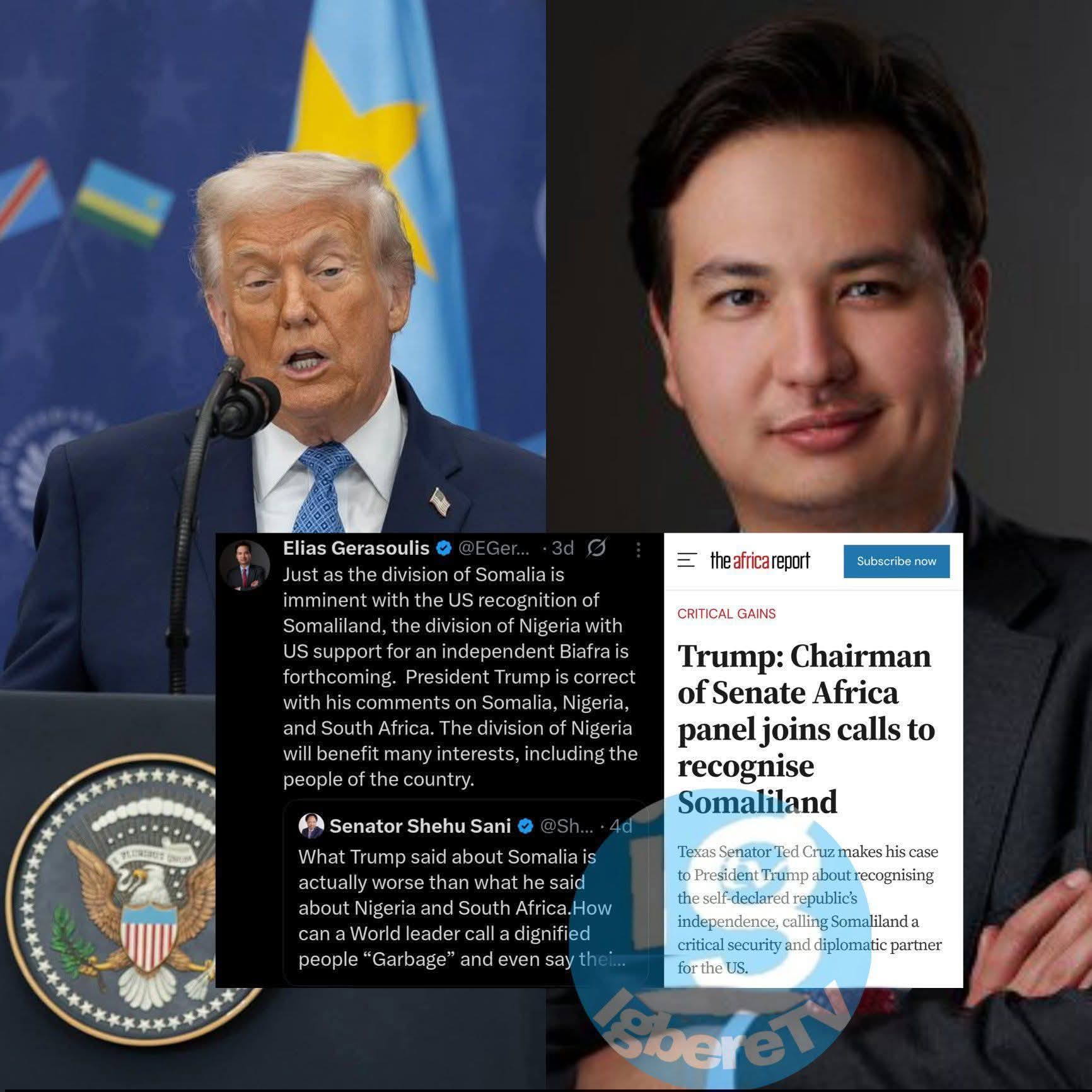
From prediction to reality. How a strategic move by Israel is rewriting the rules of sovereignty and recognition.The Geopolitical Earthquake: Unpacking Netanyahu's Somaliland Recognition and Its Global Implications
In a move that sent shockwaves through diplomatic circles and regional power structures, Israeli Prime Minister Benjamin Netanyahu’s formal recognition of Somaliland as an independent state marks a pivotal and contentious moment in modern international relations. This decision, foreshadowed just two weeks prior by a prominent Trump loyalist’s declaration that the independence of Somaliland and Biafra was “imminent,” is far more than a bilateral policy shift. It represents a potent convergence of legacy geopolitical strategies, emerging right-wing nationalist ideologies, and the calculated disruption of a decades-old world order. The ramifications extend far beyond the Horn of Africa, threatening to unravel long-standing diplomatic norms, ignite regional conflicts, and empower separatist movements worldwide.
To understand the seismic nature of this event, one must first appreciate Somaliland’s unique and protracted struggle for statehood. A former British protectorate, Somaliland voluntarily united with Italian Somalia in 1960 to form the Somali Republic. However, following the catastrophic collapse of the Somali central government and the civil war that erupted in the late 1980s and early 1990s, Somaliland declared its independence in 1991. In the three decades since, while lacking international recognition, it has built a stark contrast to its southern neighbor: a functioning, democratic government with peaceful transitions of power, a robust police force, and a growing market economy. Its capital, Hargeisa, stands as a testament to grassroots reconstruction. For years, its plea to the international community has been one of earned sovereignty based on stability and self-governance, a plea largely met with cautious ambivalence due to the sacrosanct principle of maintaining Africa’s colonial-era borders.
Israel’s decision to break this consensus is a masterclass in realpolitik with deep historical roots. Since its founding, Israel’s foreign policy has often sought alliances with non-Arab and peripheral states to break through its regional isolation—a doctrine once applied to Iran under the Shah, Turkey, and Ethiopia. Recognizing Somaliland fits a modern iteration of this strategy. Somaliland occupies a critical geostrategic position along the southern shore of the Gulf of Aden, a chokepoint for global shipping just opposite Yemen. For Israel, establishing a formal partnership here offers a potential strategic foothold near vital maritime routes and a counterbalance to Iranian influence in the Bab el-Mandeb Strait. Furthermore, it opens a new channel for security cooperation, intelligence sharing, and economic investment, particularly in port infrastructure like Berbera.
However, Netanyahu’s move cannot be divorced from its domestic and transnational political context. The prophecy from the “Trump loyalist” two weeks prior is a crucial piece of the puzzle. It signals the growing influence of a specific, disruptive school of thought within certain right-wing nationalist circles in the West. This ideology often champions a foreign policy of explicit transactionalism and overturning established diplomatic conventions, viewing the rigid adherence to territorial integrity as an obstacle to new alliances and market opportunities. For figures in this sphere, a place like Somaliland is not a problematic secession but a potential partner-in-waiting—a fellow “nation” asserting its identity against a dysfunctional, often hostile, consensus. Israel’s recognition, therefore, can be seen as both serving its immediate national interests and aligning with the foreign policy instincts of a potential future Trump administration, potentially pre-empting and cementing a key strategic relationship.
The immediate fallout is a diplomatic crisis of the first order. The Federal Government of Somalia in Mogadishu, which maintains Somaliland as an integral part of its territory, has vehemently condemned the move as a blatant violation of its sovereignty and international law. It has severed all ties with Israel and called for urgent meetings of the Arab League and the African Union (AU). The AU, founded on the principle of uti possidetis (the inviolability of colonial borders), faces perhaps its most direct challenge since the secession of South Sudan—a case that itself required a protracted civil war and a specific referendum. Netanyahu’s gambit forces the organization into a corner: either uphold its core principle and reject Israel’s move, risking irrelevance, or begin a painful, potentially destabilizing reconsideration of what constitutes statehood in Africa.
The broader, more alarming implication is the precedent set for separatist movements globally. From Biafra in Nigeria to Ambazonia in Cameroon, from Kurdistan to Catalonia, activists will point to Somaliland as evidence that persistent de facto statehood and strategic alignment can eventually shatter the glass ceiling of recognition. The message is that in an increasingly multipolar and transactional world, great power patronage can override longstanding diplomatic taboos. This injects a volatile new element into numerous frozen conflicts, potentially encouraging more aggressive assertions of independence in the hope of attracting a powerful external patron, thereby raising the risk of renewed violence.
Critics argue that Israel’s recognition is a dangerously short-sighted maneuver that prioritizes tactical gain over regional stability. They warn it will inflame tensions in the Horn of Africa, undermine the fragile Somali government, and play into the hands of terrorist groups like al-Shabaab, who thrive on narratives of foreign intervention and nationalist grievance. Furthermore, it complicates the delicate politics of the Red Sea, where Middle Eastern rivals like Saudi Arabia, the UAE, Turkey, and Qatar are already vying for influence through port deals and military bases.
In conclusion, Benjamin Netanyahu’s recognition of Somaliland is not an isolated diplomatic act but a geopolitical earthquake. It is the collision point of Somaliland’s thirty-year project of state-building, Israel’s enduring quest for strategic partners, and the disruptive foreign policy ethos of a resurgent nationalist right in the West. While it rewards Somaliland’s remarkable stability and offers Israel new strategic depth, it does so at the tremendous cost of destabilizing a fragile region, challenging the foundational principles of the African Union, and lighting a fuse under separatist movements worldwide. The world now watches with apprehension to see if this is a singular exception or the first crack in the dam of the post-colonial territorial order. The aftershocks of this decision will reverberate for years to come, redefining the rules of recognition and the very meaning of sovereignty in the 21st century.