

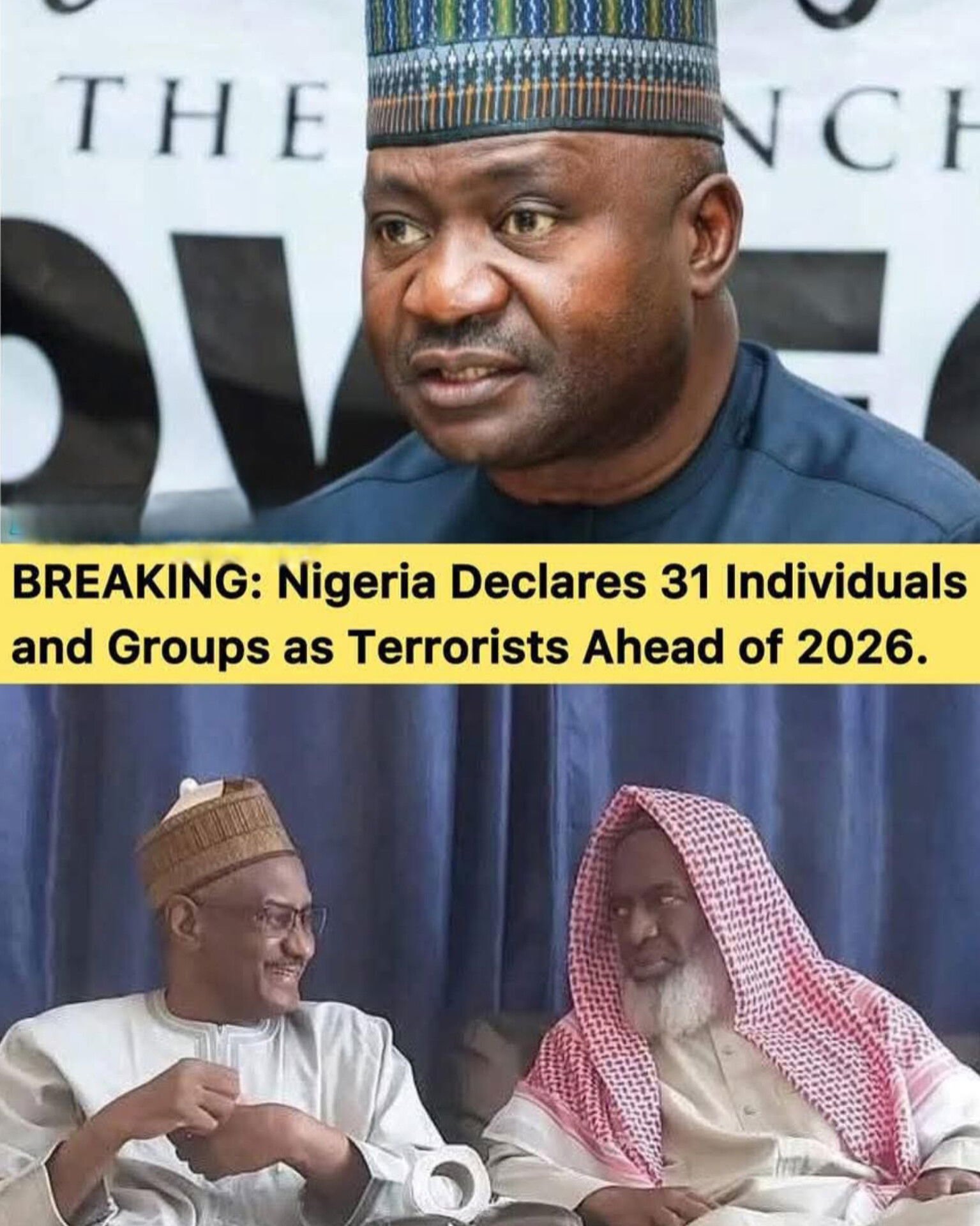
The Nigerian government has announced a new list of 31 categories of people and groups who will now be formally designated as terrorists under a fresh regulatory framework. This decisive action is framed as a critical part of ongoing efforts to combat widespread violence and enhance national security.
The Official List Includes:
1. Armed groups operating outside state authority
2. Individuals carrying weapons without official permission
3. Bandits
4. Militias
5. Armed gangs
6. Criminal networks utilizing weapons
7. Armed robbers
8. Violent cult groups
9. Forest-based armed groups
10. Foreign-linked mercenaries
11. Actors of political violence
12. Actors of ethnic violence
13. Actors of financial violence
14. Actors of sectarian violence
15. Kidnappers
16. Extortionists
17. Financiers of armed groups
18. Money handlers for terrorist activities
19. People who harbor or hide criminals
20. Informants aiding terrorist operations
21. Ransom facilitators
22. Ransom negotiators
23. Political protectors of terrorists
24. Political intermediaries for armed groups
25. Transporters of fighters or weapons
26. Arms suppliers
27. Safe house owners for terrorists
28. Politicians who encourage violence
29. Traditional rulers who support terror
30. Community leaders who aid violence
31. Religious leaders who justify terror
The government states this comprehensive measure aims to dismantle networks of violence, ensure severe punishment for all enablers of terror, and ultimately make Nigeria safer for all its citizens.
A Note to the Public:
Quietly read through and locate where you stand before you scream"had I known."
A Legal Thunderclap: Nigeria’s Expansive Terrorism Designation and the 2026 Precedent
In a move that has sent ripples through the nation’s political, security, and social landscape, the Nigerian government has unveiled a sweeping new regulation, designating 31 distinct categories of individuals and groups as terrorists. This unprecedented legal and security framework, announced with the 2026 general elections on the horizon, represents not merely a policy shift but a fundamental redefinition of the battlefront against instability. It signals a transition from targeting only headline insurgent groups to dismantling the vast, hydra-headed ecosystem that enables violence and criminality across the country. The government positions this as a decisive, comprehensive strategy to “stop violence, punish criminals, and make Nigeria safer for everyone.” However, the breadth of the list invites deep analysis, raising critical questions about implementation, civil liberties, and the very nature of terror in the Nigerian context.
Decoding the List: From Triggers to Enablers:
The list’s structure is analytically profound, moving beyond the obvious perpetrators to meticulously criminalize the entire support infrastructure. It can be segmented into several core layers:
1. The Direct Perpetrators of Violence (Categories 1-16): This foundational layer captures the armed actors plaguing Nigeria. It starts with broad, catch-all definitions like “armed groups outside state authority” and “individuals carrying weapons without permission,” which cast a wide net. It then names specific scourges: “bandits” terrorizing the northwest; “militias” and “ethnic violence actors” fueling communal crises in the Middle Belt and beyond; “violent cult groups” holding universities and southern cities hostage; “kidnappers” and “extortionists” operating as a national criminal economy; and “forest-based armed groups” that speak to the specific geography of insurgency and kidnapping. Notably, it includes “political violence actors” and “sectarian violence actors,” acknowledging the electoral and religious dimensions of conflict. This section legally conflates diverse criminal motives—ideological, economic, political—under the single, severe banner of terrorism.
2. The Financial and Logistical Spine (Categories 17-27): Here, the regulation demonstrates its strategic intent: to collapse the economic model of violence. “Financiers,” “money handlers,” “arms suppliers,” “transporters of fighters or weapons,” and “safe house owners” are explicitly named. This targets the shadow economy that fuels conflicts, from the dark-web cryptocurrency transactions funding terrorism to the local arms dealer and the landlord renting to a gang. Crucially, it zeroes in on the kidnapping industry’s architecture: “ransom facilitators,” “ransom negotiators,” and even “informants” who provide intelligence for attacks or abductions. By aiming to criminalize every transactional link in this chain, the government seeks to make violent enterprise prohibitively risky and logistically impossible.
3. The Political and Societal Sanctuaries (Categories 28-31): This is arguably the most politically charged and revolutionary layer. It directly implicates the pillars of Nigerian society that have often been accused of complicity. “Politicians who encourage violence,” “political protectors,” and “political intermediaries” point to the alleged use of thugs for electoral intimidation and the patronage networks that shield kingpins from justice. Even more striking is the inclusion of “traditional rulers,” “community leaders,” and “religious leaders who justify terror.” This acknowledges the grim reality where local authority figures sometimes provide legitimacy, cover, or doctrinal justification for violence, whether out of fear, profit, or sectarian allegiance. This layer attacks the ideological and moral cover that allows terrorism to fester within communities.
Strategic Timing and the 2026 Elections:
The announcement “ahead of 2026” is not coincidental. Nigerian election cycles are often marred by violence, from pre-election assassinations and campaign clashes to post-election riots. The designation of “political violence actors” and their enablers serves as a stark warning. It provides security agencies with a powerful legal instrument to preemptively arrest, detain, and prosecute individuals involved in organizing or inciting electoral violence, under the severe penalties associated with terrorism. It is a clear attempt to change the calculus for politicians who have historically relied on armed groups to sway outcomes. However, it also opens a door for potential abuse, where the label of “terrorist” could be weaponized against political opponents, activists, or dissenters under the guise of maintaining security.
Potential Impacts and Formidable Challenges:
The potential impacts of this policy are vast, but so are the challenges in its execution.
On the positive side, if implemented with precision and integrity, it could:
· Disrupt Ecosystems: By targeting financiers and logistics networks, it could significantly degrade the operational capabilities of violent groups, potentially more effectively than direct kinetic action alone.
· Deterrence: The severe consequences of a terrorism charge may deter community leaders, businessmen, and low-level accomplices from offering support.
· Legal Clarity: It provides a much-needed, comprehensive legal framework to prosecute complex cases that span multiple crimes (e.g., a kidnapping that funds a militia, which is protected by a local official).
However, the challenges are profound:
· Overbreadth and Civil Liberties: The definitions, particularly “armed groups outside state authority,” are exceptionally broad. In a country with widespread self-defense militias formed by communities abandoned by the state, where does legitimate, albeit illegal, self-protection end and terrorism begin? The risk of criminalizing victims is real.
· Implementation Capacity: Does Nigeria’s justice system have the capacity, forensic financial investigative units, and witness protection programs to successfully prosecute the sophisticated cases this law envisions, especially against powerful “political protectors”?
· Selective Application: The greatest test will be impartiality. Will the law be applied equally to a powerful politician’s thugs in Lagos as to a bandit kingpin in Zamfara? Or to a militia leader with connections in one part of the country versus another? History suggests that the powerful often evade such sweeping nets.
· Social Cohesion: Labeling community and religious leaders as potential terrorists is a double-edged sword. While it may curb complicity, it could also deepen distrust between the state and communities, seen as a collective punishment rather than a targeted legal action.
Conclusion: A Nation at a Legal Crossroads
Nigeria’s expansive terrorism designation is a bold, high-stakes gambit. It reflects a government’s frustration with a multifaceted security crisis and a desire to wield the full force of the state against it. The concluding public advisory—“Quietly read through and locate where you stand before you scream had I known”—is a chillingly direct communique to every Nigerian: from the arms runner and the corrupt chief, to the politician storing weapons, and the preacher inciting hatred. It states that the rules have irrevocably changed.
The success or failure of this policy will define Nigeria’s security and political trajectory towards 2026 and beyond. Its legacy will not be written in the text of the regulation, but in its application. Will it be the tool that finally dismantled the networks of violence, applied with judicial rigor and fairness? Or will it become an instrument of oppression, used to silence opposition and deepen societal fractures under the ominous shadow of a terrorism charge? Nigeria stands at a legal crossroads; the path it takes will determine whether this breaking news becomes a landmark of national recovery or a footnote in a deepening crisis. The nation watches, and the world observes, as this ambitious framework moves from proclamation to practice.