

Byline: Andrés Vásquez, Senior Diplomatic Correspondent
Dateline: BOGOTÁ, COLOMBIA
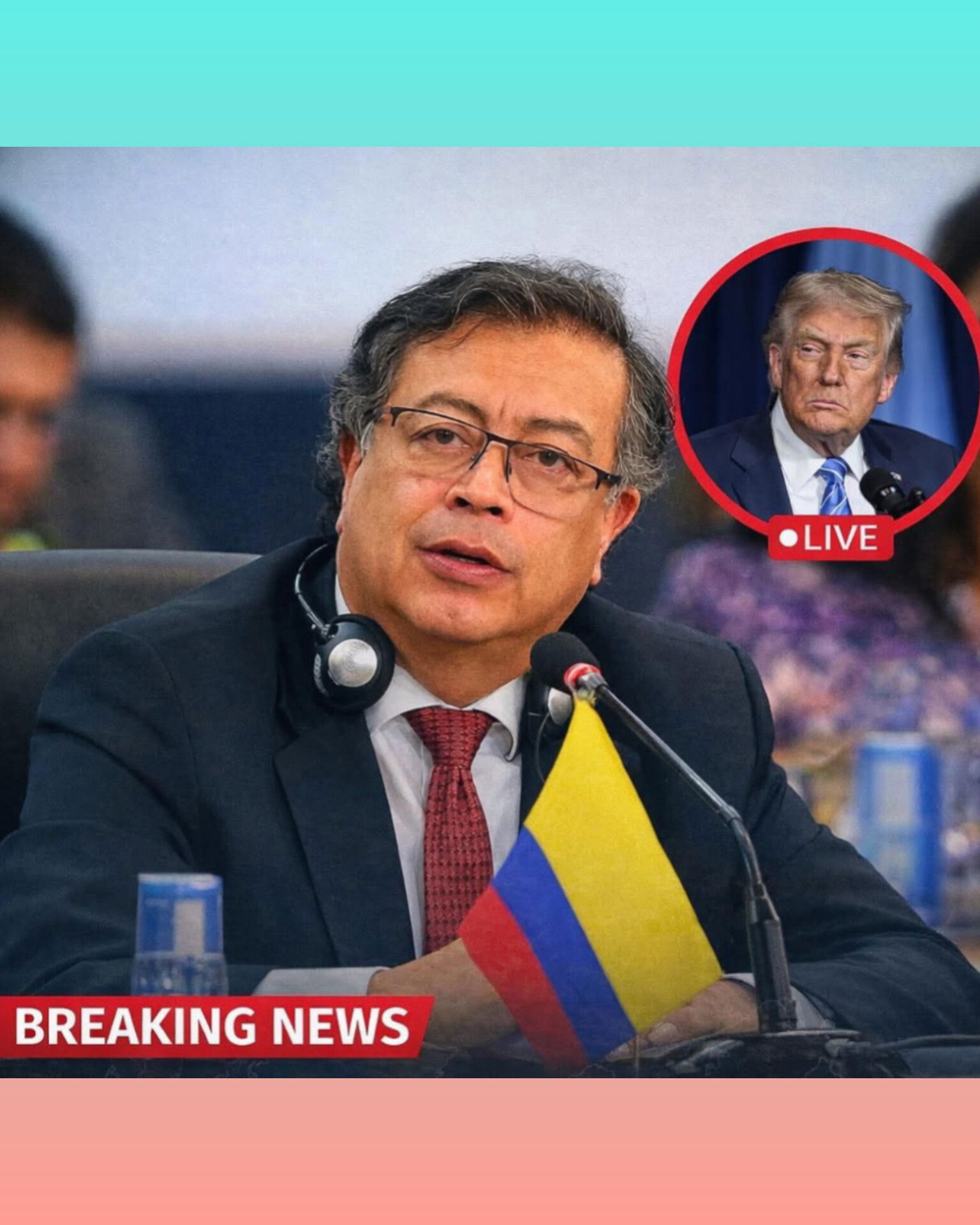
In a stark declaration that has sent ripples across the geopolitical landscape of the Western Hemisphere, Colombian President Gustavo Petro has asserted his nation’s unwavering right to defend its sovereignty against any potential foreign military intervention. This unprecedented warning, delivered via the modern-day presidential pulpit of social media, comes as a direct and forceful response to a recent surge in aggressive rhetoric from the United States, casting a long shadow over a historically pivotal bilateral relationship and raising the specter of a profound regional realignment.
The immediate catalyst for President Petro’s statement was a series of remarks from former U.S. President Donald Trump, whose amplified voice on the campaign trail continues to shape international discourse. In the context of discussing an expanded U.S. anti-narcotics strategy, Trump turned his focus southward, explicitly naming Colombia as a target for increased pressure. He leveled a grave accusation: that Colombian authorities, in his view, have failed catastrophically in controlling the flow of cocaine to American streets. This critique, laden with implication, did not stop at bureaucratic failure; it cast a pall over the nation’s leadership itself.
For President Petro, Colombia’s first leftist head of state, a former guerrilla member turned advocate for social reform and peaceful negotiation, the allegation struck at the core of his political identity and his government’s hard-fought legitimacy. The response was swift and unyielding. In a carefully worded yet potent message disseminated to his millions of followers, Petro categorically rejected the insinuations of complicity in the illicit drug trade, denying any personal or governmental involvement. But he moved beyond mere rebuttal, elevating the discourse to the fundamental principle of national sovereignty.
“I have been a man of peace and non-violence my entire life,” President Petro stated, anchoring his argument in his well-documented personal history. “But let it be clear to all: the people of Colombia, through their democratic institutions, possess the inalienable right to protect our independence, our territorial integrity, and our constitutional order against any external threat.” He framed his remarks not as a bellicose threat but as a sober, necessary warning—a drawing of a red line meant to deter escalation rather than invite it. “This is not a call to arms,” he underscored, “but a reaffirmation of our dignity and our right to exist as a free nation, not a protectorate.”
Observers in Bogotá and international capitals parsed the subtext: this was a direct allusion to recent U.S. military operations in neighboring Venezuela and the stated U.S. objective of detaining Venezuelan leader Nicolás Maduro. The Petro administration, while critical of Maduro’s government, has been a vocal opponent of foreign intervention in Venezuela, arguing it sets a dangerous precedent and exacerbates humanitarian suffering. Trump’s comments about Colombia were interpreted through this lens, not as isolated criticism on drug policy, but as a potential prelude to a more muscular, unilateral approach that could one day cross the border from Venezuela into Colombia.
Unswayed, the former U.S. president later intensified his critique. In subsequent interviews, he doubled down, asserting that Colombia remains the primary source of cocaine flooding into the United States and openly questioning the capability and will of its current leadership. When pressed by journalists on what “increased pressure” might entail and whether further U.S. action in the region was conceivable, Trump offered ambiguous but ominous replies. He spoke of “all options” being on the table and the need for “strong measures,” language that diplomatic and security analysts uniformly interpreted as a significant ratcheting up of tensions. This verbal escalation transformed a policy disagreement into a public test of wills between two heads of state, one current and one aspiring to return to power.
A Relationship at a Crossroads: From Unshakeable Ally to Strained Partnership:
The exchange lays bare the profound and growing diplomatic strain between Washington and Bogotá, a relationship once described as the “cornerstone” of U.S. policy in Latin America. For decades, through the fraught chapters of the drug wars and the internal conflict with the FARC guerrillas, Colombia stood as the United States’ most reliable military and political partner in the region. Billions of dollars in aid, primarily under the Plan Colombia and later Peace Colombia frameworks, flowed south, financing a security-centric approach that prioritized eradication, interdiction, and the strengthening of the Colombian military.
President Petro’s election in 2022 represented a seismic shift in this paradigm. His administration has undertaken a radical reorientation of Colombia’s domestic and foreign policy. Domestically, he champions a policy he calls “Total Peace,” seeking negotiated settlements with all remaining illegal armed groups, including dissident factions of the FARC and the powerful Gulf Clan narcotics cartel. His approach to the drug trade is fundamentally different from that of his predecessors and his counterparts in Washington. Petro argues that cocaine production is a symptom of deep-rooted poverty, state neglect, and lack of opportunity in rural Colombia. His solutions focus on voluntary crop substitution, comprehensive rural development, and providing alternative livelihoods to coca farmers—a direct challenge to the U.S.-favored model of forced eradication and aerial fumigation.
On the international stage, Petro has pursued a fiercely independent path. He has restored diplomatic relations with Venezuela, a nation the previous Colombian government and the U.S. sought to isolate. He has been a leading voice condemning the war in Gaza and, more broadly, has positioned Colombia as a leader of the Global South, advocating for climate justice and a restructuring of international financial systems. To traditional power centers in Washington, this independent streak, coupled with his past as a militant, has often been viewed with deep skepticism and unease.
U.S. officials, from the State Department to the Drug Enforcement Administration (DEA), continue to express persistent and public concerns. Their focus remains fixed on the metrics of cocaine production, which remain near historic highs according to U.S. estimates, and the pervasive influence of armed groups who control much of the trafficking routes. They warn that Petro’s peace talks could legitimize criminals and that a reduction in forced eradication could lead to an even greater surge in coca cultivation. The dialogue between the two nations has become a dialogue of the deaf, with Washington emphasizing security outputs and Bogotá emphasizing social and economic inputs.
The Broader Canvas: Regional Instability and Strategic Anxiety:
Petro’s warning cannot be divorced from the wider context of hemispheric anxiety. The recent U.S. military incursion into Venezuelan airspace, framed by Washington as a counter-narcotics operation, was viewed across Latin America as a stark demonstration of unilateral power. For leaders like Petro, it reinforced a long-held conviction that the principle of non-intervention, a cornerstone of Latin American diplomacy since the 19th century, remains perpetually fragile when confronted by U.S. strategic interests.
In his statements, Petro has repeatedly warned that a militarized approach to the drug trade is a proven failure. He argues that it destabilizes communities, fuels violence, displaces populations, and undermines long-term regional security. “You cannot shoot your way out of a social problem,” he has often stated. His vision is one of integrated regional development, where tackling inequality and lack of governance is seen as the only sustainable path to reducing both drug production and the migratory crises that increasingly affect the Americas.
The political calendar adds another layer of volatility. With a U.S. presidential election approaching, the future of U.S.-Colombia relations hangs in the balance. A second Trump administration could indeed seek to implement the “increased pressure” he has hinted at, which could range from drastic cuts in aid and economic sanctions to, in the most extreme scenarios hinted at in the rhetoric, some form of coercive action. Such a path would likely fracture the relationship irreparably, push Colombia closer to other global actors like China, and destabilize the entire Andean region.
Conversely, the current Biden administration, while sharing many of the concerns about drug policy, has pursued a more diplomatic, albeit frustrated, engagement with Petro. The potential for a recalibration exists, but it would require difficult compromises: the U.S. accepting a greater role for social programs in anti-narcotics strategy, and Colombia demonstrating tangible, verifiable results in reducing the power of armed groups and the flow of drugs.
On the Ground: The Human Dimension of a Geopolitical Storm:
Beyond the statements of presidents and the analyses of diplomats, this escalating tension reverberates in the verdant valleys and remote mountains where coca is grown. For farmers like María Fernanda Rodríguez in the department of Caquetá, the abstract debate is a matter of daily survival. “For years, planes came and sprayed our food crops along with the coca. Our children got sick. The government promised us help to plant other things, but it comes slowly, if at all,” she explains. “Now we hear the gringos might send soldiers? That is our worst nightmare. We are not criminals; we are people trying to feed our families.”
Her fear underscores Petro’s central argument: that treating a complex socioeconomic issue as a purely military target perpetuates a cycle of violence and mistrust. Colombian military commanders, for their part, express professional unease. They are caught between a U.S. ally that has trained and equipped them for decades and a commander-in-chief who is fundamentally redefining their mission. “Our loyalty is to the constitution and the elected president,” a senior officer, speaking on condition of anonymity, stated. “But the partnership with the U.S. Southern Command is deeply embedded in our logistics, intelligence, and strategy. A rupture would be a seismic event for our operational capacity.”
Analysis: A Defining Moment for Colombian Sovereignty:
President Petro’s sovereign defense is arguably the most significant foreign policy declaration of his presidency to date. It is a calculated gamble. On one hand, it galvanizes his domestic base, which cherishes independence from Washington, and positions him as a defiant leader of Latin American sovereignty. It draws a clear line for any future U.S. administration, asserting that the era of uncontested U.S. influence is over.
On the other hand, it risks alienating a powerful neighbor and vital economic partner. The United States remains Colombia’s largest trading ally, and significant sectors of the Colombian elite, military, and business community maintain deep ties to the north. A prolonged crisis could spook investors and complicate access to crucial international financial markets.
Ultimately, the Petro-Trump exchange is more than a war of words. It is a symptom of a deeper clash of visions. It is the “War on Drugs” paradigm, born in the late 20th century, colliding with a 21st-century vision of “Total Peace” and regional self-determination. It is the assertion of hemispheric hegemony meeting the rise of a confident, ideologically distinct Latin America.
As the dust from this diplomatic confrontation settles, the path forward is fraught with risk. The potential for miscalculation is high, and the stakes—for regional stability, for the fight against organized crime, and for the democratic futures of both nations—are even higher. Colombia has planted its flag on the principle of sovereignty. The world now watches to see whether this stand will lead to a renewed and more equitable dialogue, or whether it marks the beginning of a new and turbulent chapter in the often-complicated story of the Americas. One thing is certain: the cornerstone of U.S.-Latin American relations has developed a significant crack, and its repair, if possible, will require a new blueprint altogether.