

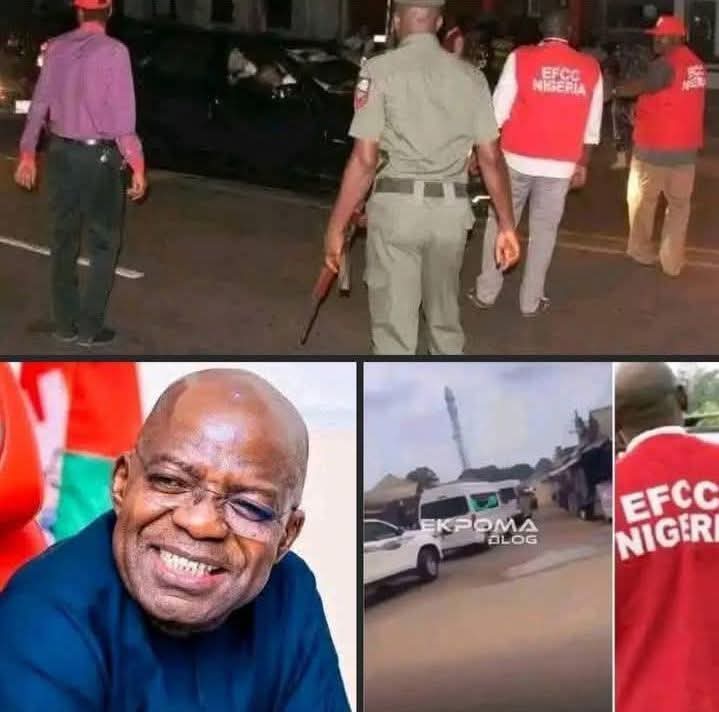
DATELINE: ABA, ABIA STATE – In an unprecedented confrontation that has sent seismic shockwaves through Nigeria’s political and law enforcement establishments, the Abia State Government, under the direct orders of Governor Dr. Alex Otti, yesterday physically intercepted and blockaded the convoy of the Economic and Financial Crimes Commission (EFCC) on the outskirts of Aba. The dramatic standoff culminated in the forced release of fifty-nine youths arrested by the anti-graft agency and their immediate discharge, with the Governor issuing a stern directive for the operatives to leave the state’s territory forthwith.
The incident, which unfolded over several tense hours near the Osisioma interchange along the Aba-Port Harcourt Expressway, represents a direct and monumental challenge to federal authority, raising profound constitutional questions about the limits of state power, federal agency operations, and the politically volatile issue of regional security dynamics.
THE SEQUENCE OF A CONFRONTATION:
According to multiple eyewitness accounts from security officials, government aides, and local residents, the operation began in the early hours of yesterday. A large detachment of EFCC operatives, believed to have been deployed from outside the state, conducted simultaneous raids on several digital business centres, gaming lounges, and residential buildings in the bustling commercial heartlands of Aba, including Ogbor Hill, Asa Nnentu, and Faulks Road.
The Commission’s operatives, in what witnesses described as a vigorous operation, rounded up dozens of young men, predominantly in their twenties and thirties. The EFCC, in a terse preliminary statement later, asserted the arrests were part of “an ongoing cybercrime crackdown,” alleging the individuals were suspected of internet fraud, identity theft, and financial malfeasance.
By mid-morning, the detained youths had been processed and loaded into several blacked-out EFCC detention buses and utility vehicles, with the convoy preparing for the long journey to the agency’s operational headquarters in Abuja for further interrogation and potential arraignment.
It was at this juncture that Governor Otti’s administration sprang into action. Alerted to the scale and nature of the arrests, the Governor, according to authoritative government sources, immediately made a series of frantic telephone calls to senior EFCC officials in Abuja, demanding an explanation and the release of those detained. Dissatisfied with the responses and determined to prevent the movement of the youths out of Abia, Otti issued a decisive order.
A combined team of the Governor’s Security Detail, reinforced by units of the Abia State Police Command acting on the directive of the State Commissioner of Police—who reports to the Governor in the state’s security architecture—and elements of the Abia State Vigilante Service, mobilized at speed. Using an array of official vehicles, they strategically positioned themselves ahead of the EFCC convoy, bringing it to a complete halt on the busy highway.
THE STANDOFF AND THE GOVERNOR’S DIRECT INTERVENTION:
What followed was a tense, gridlocked impasse. Armed security personnel from both sides stood in cautious confrontation, as traffic backed up for kilometres. Senior state officials, including the Secretary to the State Government and the Chief of Staff, arrived at the scene to negotiate. However, the situation reached its climax with the unexpected arrival of Governor Alex Otti himself.
Stepping out of his official vehicle amidst a palpable surge of anxiety and anticipation from a growing crowd of onlookers, the Governor approached the lead EFCC vehicles. In a moment captured on countless smartphones and now circulating virally across social media platforms, Governor Otti addressed the senior EFCC operative in charge in a voice laden with unmistakable fury and defiance.
“Aba boys are not thieves or killer herdsmen,” the Governor declared, his words cutting through the humid air. “No such arrests of my people will happen under my watch. This operation, in its manner and target, is unacceptable. You will release every single one of these young men, right here, right now.”
He then delivered the line that has become the defining soundbite of the crisis, a statement loaded with deep political and ethnic connotations that is sure to be analysed and debated for weeks to come: “Head back to Sokoto and arrest the Fulani herdsmen, not innocent Aba youths.”
The directive was a clear, provocative reference to the ongoing national crisis of kidnapping and banditry, often attributed to elements among Fulani pastoralist communities, with Sokoto State in the northwest being one of the epicentres. The remark instantly framed the Governor’s actions not merely as a defense of his citizens but as a pointed accusation of selective enforcement and ethnic bias against the Igbo populace of the southeast.
Faced with the overwhelming physical presence of state-backed security and the unequivocal command of the sitting Governor, the EFCC team had little room for manoeuvre. One by one, the doors of the detention vans were unlocked, and the fifty-nine dazed and relieved young men disembarked onto the tarmac, their personal effects returned. After a final, tense exchange of paperwork, the EFCC convoy, now empty of detainees, was turned around and escorted to the state boundary, complying with the Governor’s order to “leave Aba at once.”
CONSTITUTIONAL AND POLITICAL EARTHQUAKE:
The ramifications of this event are immediate and staggering. Legal experts are divided into sharp camps. Some constitutional lawyers, like Professor Nnamdi Obiora of the Nigerian Law School, have labelled the Governor’s action “a flagrant violation of the constitutional order.”
“The EFCC is a legitimate federal agency created by an Act of the National Assembly. While there may be questions about its operational conduct, the physical blockade of its officials and the compelled release of suspects in its custody is an assault on the doctrine of separation of powers and the rule of law,” Professor Obiora stated. “It sets a dangerous precedent where any governor can obstruct federal law enforcement based on political or ethnic sentiment.”
Conversely, another school of thought, championed by rights activists and some regional political analysts, applauds Governor Otti’s intervention as a necessary check against perceived federal overreach and profiling. Barrister Grace Ezeugo, a human rights advocate in Enugu, argued, “The EFCC’s operations in the southeast have often been viewed through a lens of ethnic suspicion—mass arrests of ‘yahoo boys,’ often with little immediate evidence presented. The Governor, as the Chief Security Officer of the state, has a duty to protect his citizens from potential harassment or arbitrary detention. His action is a bold statement against profiling.”
Politically, the event has ignited a firestorm. Supporters of Governor Otti and many across the Igbo socio-political landscape have hailed him as a courageous defender of his people. Within hours, Otti The Defender and Aba Boys Are Not Thieves began trending nationally on social media. The atmosphere in Aba and Umuahia is one of jubilation and renewed solidarity with the state government.
However, in Abuja, the reaction is one of stunned fury. While the EFCC’s headquarters has yet to issue a comprehensive official statement, sources within the Commission describe “a state of outrage” and a feeling that its authority has been “gravely undermined.” The Attorney-General of the Federation’s office is reportedly in emergency consultations. The potential for a major institutional clash is high, with possibilities ranging from the EFCC filing contempt charges or re-arresting the youths through different means, to a political showdown requiring the intervention of the Presidency and the National Security Council.
CONTEXT: ABA, SECURITY, AND THE SPECTRE OF REGIONAL TENSION:
To fully comprehend the explosiveness of this event, one must understand the unique place of Aba in the southeastern psyche. Aba is the iconic commercial nerve-centre of Igboland, a city renowned for its resilient, entrepreneurial spirit—the “Japan of Africa.” Its predominantly youthful population is a mix of traders, artisans, and a growing number of tech-savvy entrepreneurs navigating the digital economy. This same vibrancy, however, has also made it a focal point for EFCC cybercrime raids over the years, breeding deep-seated resentment and a perception that these operations are disproportionately heavy-handed and stigmatizing.
Furthermore, Governor Otti’s specific reference to “killer herdsmen” taps directly into the most raw and sensitive security nerve in southern Nigeria. Decades of farmer-herder conflicts have morphed into a severe crisis of kidnapping, rape, and village raids across the Middle Belt and southern states, often attributed to armed Fulani militias. The perceived slowness and inadequacy of the federal security response to this crisis, especially in contrast to swift actions like the EFCC’s Aba raid, has fostered a bitter narrative of bias and neglect in the southeast.
Governor Otti, an economist and former bank CEO, has built his administration on a platform of security and infrastructural revival. By taking this stand, he has positioned himself not just as a state administrator, but as a regional champion, directly challenging the federal government’s security approach and its agencies’ modus operandi. This aligns with a growing sentiment among southern governors for greater control over security architecture, often framed as the need for state police.
WHAT NEXT: A NATION ON A KNIFE-EDGE:
The immediate aftermath sees fifty-nine young men back with their families in Aba, a humiliated EFCC licking its wounds, and a state government basking in popular acclaim but staring down a potential constitutional tsunami. The released youths have not been formally cleared of any alleged crimes; they exist in a legal limbo, their status a lingering point of conflict.
The federal government’s response will be critical. A heavy-handed attempt to reassert authority could inflame regional passions further and solidify Governor Otti’s defiant stance as a cause célèbre. A quiet diplomatic resolution, perhaps through behind-the-scenes negotiations and a review of EFCC arrest protocols, might defuse the situation but could be seen as weakness by federalists and embolden other governors.
This is more than a news story; it is a crystallization of Nigeria’s most profound challenges: the fragile balance between federal and state power, the ethnicization of law enforcement, the quest for security justice, and the volatile relationship between a dynamic, sometimes restive southeast and the federal centre. The blockade on the Osisioma interchange was not just of vehicles; it was a blockade of a certain national narrative. Governor Alex Otti has thrown down the gauntlet. The nation now watches, with bated breath, to see how Abuja will pick it up. The repercussions of this single day in Aba will undoubtedly echo through courtrooms, the National Assembly, and the very fabric of the Nigerian federation for a long time to come.