

SUBHEADLINE: Precision Operation in Faskari Forest Neutralises High-Value Targets, Disrupts Syndicate Leadership; Defence Headquarters Vows Sustained Pressure on Terror Elements
BYLINE: By Ahmad Tukur, Chief Defence Correspondent
In a devastatingly precise aerial intervention, the Nigerian Air Force, in seamless coordination with ground assets of the Nigerian Army, successfully neutralised a major congregation of armed bandits in the remote Yan Tumaki forest area of Faskari Local Government, Katsina State, on Tuesday afternoon. Authoritative military intelligence sources confirmed to this newspaper that the operation, predicated on real-time surveillance, struck a gathering where a cohort of notorious bandits were conducting funeral rites for associates previously killed in security operations. Initial Battle Damage Assessment (BDA) indicates no fewer than 23 confirmed combatant casualties, with several key figures among the neutralised targets.
The operation, codenamed ‘WUTAN DAJI’ (Forest Sweep), marks one of the most significant single-engagement successes in the ongoing joint security campaign within the North-West theatre, underscoring a strategic shift towards proactive, intelligence-driven strikes against terrorist and bandit sanctuaries.
THE INTELLIGENCE PICTURE: A GATHERING STORM IN THE FOREST:
According to highly placed sources within the Defence Headquarters (DHQ), the operation was the culmination of days of meticulous intelligence gathering. Human Intelligence (HUMINT) from local communities, corroborated by relentless aerial surveillance from unmanned aerial vehicles (UAVs) and NAF reconnaissance platforms, revealed unusual activity deep within the Faskari forest, a known corridor for bandits moving between Katsina, Zamfara, and Kaduna States.
“We had been tracking a particular cell responsible for a series of kidnappings along the Faskari-Sheme axis and attacks on agrarian communities,” a senior intelligence officer, who spoke on condition of anonymity due to the sensitivity of the operations, explained. “Our assets identified a large assembly at a known enclave. Further monitoring confirmed they were preparing for burial rituals. This presented a target of opportunity, as many key players were present in one location, momentarily stationary and with their guard potentially lowered.”
The intelligence, processed at the Joint Task Force (JTF) North-West command centre, painted a clear picture: this was not a civilian gathering. The profile of movements, the presence of armed sentries on perimeter watch, and the identification of several individuals on the watchlist confirmed the assembly as a hostile force congregation.
THE STRIKE: PRECISION AND OVERWHELMING FORCE:
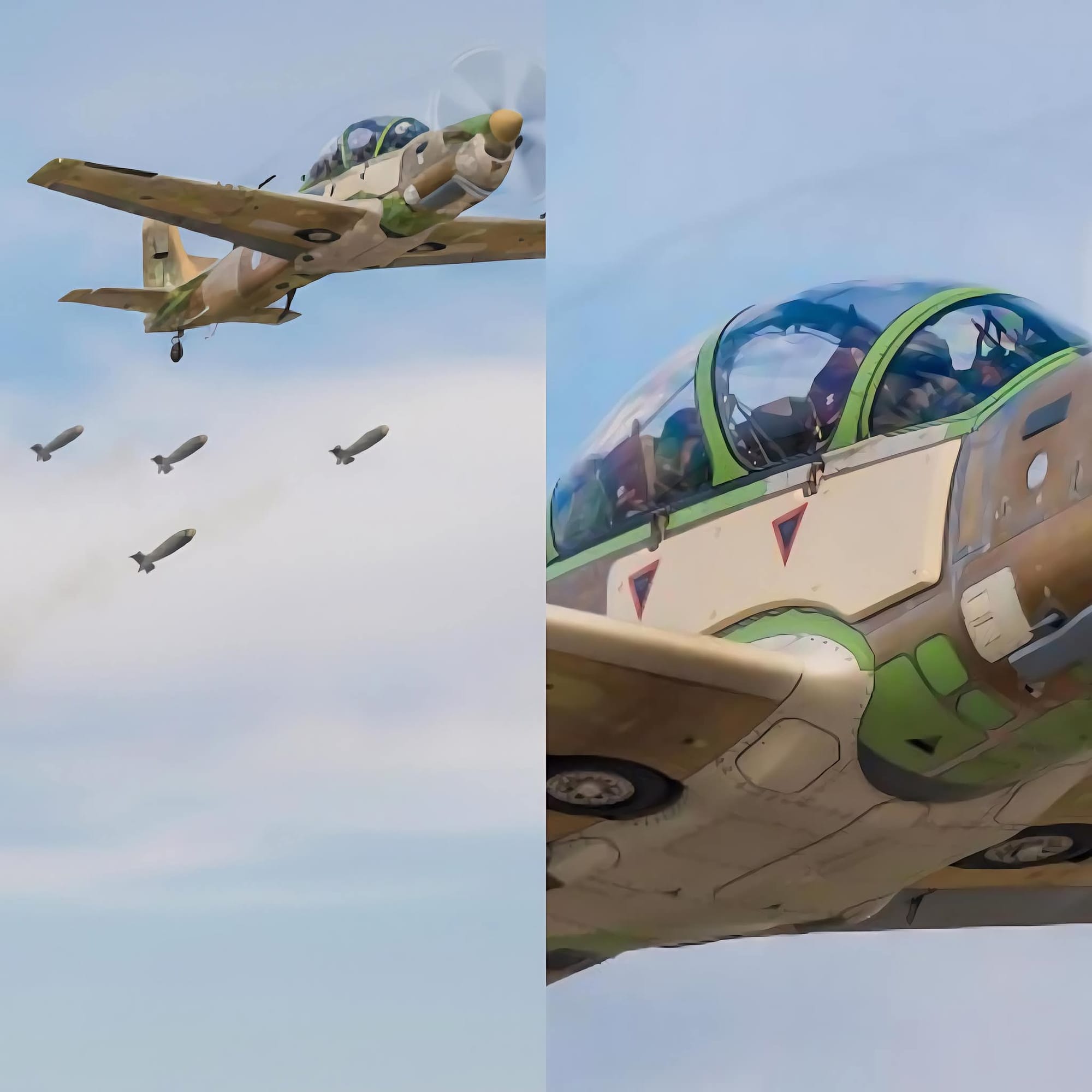
At approximately 14:30 hours, following final verification and strict adherence to rules of engagement to preclude civilian presence, the order was given. A formation of NAF aircraft, including the lethal Super Tucano A-29 ground attack aircraft, was scrambled from a forward operating base. The aircraft, laden with precision-guided munitions, loitered at a safe distance until the final executive command.
“The strike was clinical,” stated an officer familiar with the BDA. “The munitions impacted the designated coordinates with high accuracy. The gathering was engaged during the burial proceedings, leading to maximum disruption. Our post-strike footage shows no secondary explosions, indicating this was primarily a personnel target, not a logistics or armoury site.”
Ground troops from the Nigerian Army’s 17 Brigade, operating under Operation Hadarin Daji, were placed on high alert and subsequently moved to secure the perimeter, preventing any fleeing survivors from escaping into adjoining communities and to conduct on-site assessment.
THE AFTERMATH: CONFIRMED NEUTRALISATION AND SECURING THE AREA:
Initial feedback from the ground forces, who cautiously advanced on the smouldering location hours after the strike, confirmed the efficacy of the operation. “We have counted 23 bodies so far, all male, all in tactical attire typical of the bandit groups,” a field commander relayed via secure communication. “We have recovered a significant number of weapons, including AK-47 rifles, locally fabricated launchers, and a large cache of ammunition. Communication gadgets, motorcycles, and other logistics were also destroyed.”
Most critically, sources indicate that among the neutralised were at least two high-value targets (HVTs) identified as cell leaders coordinating ransom collections and attacks on infrastructure. Their identities are being cross-referenced with existing databases. The military has emphatically stated that all casualties were combatants, with no women or children present at the strike location, a fact they assert is verifiable by their footage.
COMMUNITY REACTION AND THE HUMAN TERRAIN:
News of the airstrike sent ripples through surrounding villages, which have borne the brunt of banditry for years. In Faskari town, the mood was cautiously optimistic. “We heard the sounds of the jets, and later the explosion,” said Mallam Usman Sani, a community leader. “When the news reached us that it was the Air Force hitting the bandits, we gave thanks to Allah. These people have taken our peace, our livelihoods, and our children. Any action that reduces their number is a welcome development.”
However, the caution stems from a grim history of reprisals. Past successful operations have sometimes been followed by vicious retaliatory attacks on soft targets. The military is acutely aware of this. “Our ground forces are not just mopping up; they are establishing a presence and working with the Katsina State Community Watch Corps to reassure communities and thwart any reprisal attempts,” stated Major General Edward Buba, Director of Defence Media Operations, in a subsequent briefing in Abuja.
STRATEGIC CONTEXT: A SHIFT IN DOCTRINE AND INTER-AGENCY SYNERGY:
Analysts view this strike as emblematic of a refined and more aggressive operational doctrine. “This operation showcases the maturation of our intelligence fusion cells,” commented Security Analyst Dr. Chidi Nwaonu. “It’s not just about reacting to attacks anymore. It’s about using technology and human networks to find, fix, and finish these groups in their sanctuaries. Striking during a gathering like a burial, while controversial in some quarters, demonstrates a willingness to exploit enemy vulnerabilities without hesitation, which is a principle of asymmetric warfare.”
The success also highlights improved synergy. The operation depended entirely on the seamless flow of intelligence from DSS and local vigilantes (under supervision), to the NAF for action, and finally to the Army for ground consolidation. This level of inter-service coordination has historically been a challenge.
OFFICIAL STATEMENTS AND THE WAY FORWARD:
The Defence Headquarters, in a statement signed by Major General Buba, took responsibility for the operation. “The air strike was executed at a location near Yan Tumaki in Faskari LGA of Katsina State, where bandits had gathered for the burial of a notorious fighter killed in a previous operation. The strike was based on credible intelligence and the outcome was effective. Over 23 terrorists were confirmed neutralised. We assure Nigerians of the unwavering commitment of the Armed Forces to eradicate terrorism and banditry.”
Governor Dikko Umaru Radda of Katsina State, while commending the security forces, called for sustained efforts. “We are grateful for this major breakthrough. It is a testament to what is possible with strong political will and collaboration. However, the war is not over. We must continue to support our security agencies and simultaneously pursue the kinetic and non-kinetic approaches, including dialogue where possible and massive investment in youth empowerment.”
ETHICAL CONSIDERATIONS AND LEGAL FRAMEWORK:
International humanitarian law permits strikes on legitimate military targets, and combatants lose their protection from attack regardless of their activity at the time of engagement, if in a coordinated gathering. The military maintains that all protocols were followed. “A gathering of armed individuals, openly bearing arms, in a known terrorist enclave, constitutes a lawful military objective. The legality is clear-cut,” affirmed a military legal advisor.
Human rights organisations, while acknowledging the state’s duty to protect citizens, have called for continued transparency. “We urge the military to make public, as much as operational security allows, the evidence that confirms the exclusively combatant nature of the casualties. This is crucial for maintaining public trust and upholding the principles of distinction and proportionality,” stated a release from the Centre for Civilian Rights.
CONCLUSION: A RESOUNDING BLOW, BUT A PROTRACTED CAMPAIGN:
The Faskari forest airstrike represents a significant tactical and psychological victory for Nigerian security forces. It has demonstrably degraded one bandit cell, eliminated leadership, and disrupted planned operations. It sends a potent message of reach and capability to the adversaries.
Yet, as security experts and local residents alike concede, one operation does not end an insurgency. The vast, unforgiving terrain of the North-West, coupled with deep-seated socio-economic drivers of the conflict—poverty, unemployment, weak governance, and proliferation of small arms—means the campaign remains protracted. The success of ‘WUTAN DAJI’ must be replicated consistently across multiple theatres, supported by robust governance and community-driven deradicalisation and rehabilitation programmes.
For now, in the scarred but resilient communities of Katsina, there is a fleeting sense of respite, a whispered hope that the tide may be turning, one precise strike at a time. The military, for its part, has signalled its intent: no sanctuary is safe, no gathering is inviolable, for those who choose the path of violence against the Nigerian state and its people. The battle for the soul of the North-West continues, but Tuesday’s operation in Faskari will be recorded as a decisive day in that long and arduous struggle.