

BYLINE: By Our Chief Political Correspondent
ABUJA, NIGERIA
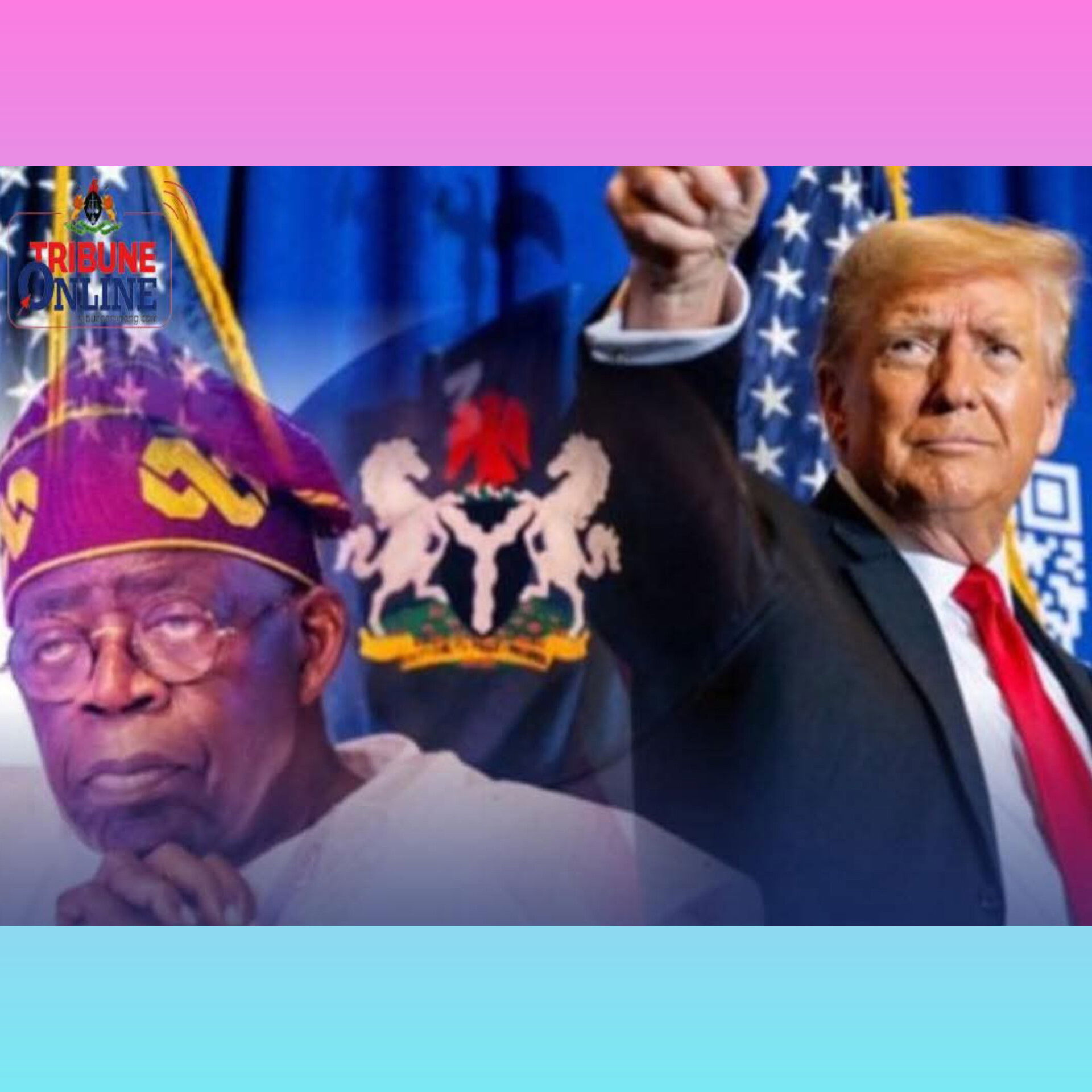
In a dramatic intervention that has fused Nigeria’s fraught electoral history with the turbulent spectre of American politics, a prominent critic of the government has issued a stark, unconventional warning to President Bola Ahmed Tinubu. Professor Adetokunbo Pearse, a public affairs analyst and former gubernatorial candidate, has declared that former U.S. President Donald Trump could personally intervene to “capture” Nigeria’s “war chambers” should the 2027 general elections be marred by rigging.
The statement, made during a televised interview on a national current affairs programme, has sent shockwaves through political circles, triggering a complex debate about Nigeria’s democratic integrity, its place in the international order, and the bizarre intersection of domestic politics and global populist figures.
“The whole international world is watching,” Pearse asserted, his tone severe. “If you rig the election the way you normally do, you may have Trump coming to get your war chambers. Everybody should be warned.”
DECODING THE PROVOCATIVE STATEMENT:
Analysts and political observers have spent the last 48 hours parsing the layered implications of Pearse’s warning. On its surface, the comment invokes the image of a direct, almost cinematic, intervention by Donald Trump—who is currently campaigning for a return to the White House in the November 2024 U.S. election—into Nigerian sovereignty. The phrase “coming to get your war chambers” is interpreted as a metaphor for targeting the central command of any electoral manipulation, potentially implying sanctions, asset seizures, or other forms of punitive international action led by a hypothetical Trump administration.
Professor Pearse, when contacted for elaboration, stood by the core sentiment of his remarks. “My message is not about the individual, Donald Trump, per se,” he explained to our newspaper. “It is about the changing axis of global power and accountability. The old, polite diplomacy of the past is eroding. There is a rise of Western leaders, particularly in America, who are less constrained by traditional diplomatic niceties and more willing to take unilateral, drastic action against regimes they perceive as corrupt or anti-democratic. President Tinubu and the ruling APC should understand that the world’s patience with Nigeria’s cyclical electoral controversies is wearing dangerously thin.”
The reference to “the way you normally do” is a direct, unsubtle indictment of Nigeria’s electoral history, particularly under the past three administrations—including President Tinubu’s own controversial victory in February 2023, which is still being challenged in the court of public opinion and, for some time, in the judiciary. Pearse’s warning taps into a deep-seated national cynicism regarding the credibility of polls, marked by allegations of vote-buying, intimidation, and technological failures with the BVAS (Bimodal Voter Accreditation System) and IReV (INEC Results Viewing Portal).
OFFICIAL AND POLITICAL REACTIONS: DISMISSAL, OUTRAGE, AND CONCERN:
The reaction from the government and the ruling All Progressives Congress (APC) has been one of swift dismissal and condemnation. The Presidency, through Special Adviser on Information and Strategy, Bayo Onanuga, issued a terse response.
“The federal government does not engage with fantastical and hallucinatory statements designed for media sensationalism,” Onanuga stated. “Nigeria is a sovereign nation with robust democratic institutions. Our electoral processes are continually being refined and are solely the business of the Nigerian people, governed by our laws and our independent electoral body, INEC. To suggest that any foreign leader, past or prospective, would ‘capture’ any part of our government is not only ludicrous but an affront to national dignity. Professor Pearse should seek help for his evident Trump derangement syndrome.”
The APC National Publicity Secretary, Felix Morka, echoed this, accusing Pearse of “importing foreign political distractions” and “attempting to delegitimize the 2027 election before a single ballot has been printed.” He added, “This is the desperate rhetoric of an opposition that has no coherent agenda and must resort to invoking foreign bogeymen.”
However, within opposition camps and civil society, the reaction has been more nuanced. While many have distanced themselves from the specific invocation of Trump, they have affirmed the underlying message about international scrutiny.
“We may quarrel with the messenger’s choice of analogy, but the message itself is urgent,” said Chidi Odinkalu, a respected human rights lawyer and governance expert. “The European Union, the Commonwealth, and the United States have all issued critical reports on our last elections. The financial and visa sanctions imposed on specific individuals for undermining democracy are a matter of record. The idea that Nigeria operates in a vacuum is false. Professor Pearse has crudely highlighted a real pressure point: that Nigeria’s global standing and the personal freedoms of its political elite are tethered to its democratic conduct.”
A senior diplomat from a Western embassy in Abuja, speaking on strict anonymity, offered a more grounded perspective. “The notion of a U.S. president, any U.S. president, leading a commando raid on Aso Rock is, of course, absurd,” the diplomat said. “But the underlying threat of severe consequences is very real. U.S. policy, whether under a Biden or a Trump administration, has mechanisms—the Global Magnitsky Act, visa restrictions, targeted financial sanctions—that can make life very uncomfortable for individuals deemed to be involved in significant corruption or democratic subversion. That is the sober reality some here choose to ignore.”
THE TRUMP FACTOR: A PLAUSIBLE THREAT OR POLITICAL THEATER?
The core of the controversy lies in the name-drop of Donald J. Trump. Pearse’s warning hinges on two uncertain futures: that Trump will win the U.S. presidency in November 2024, and that his second-term foreign policy would involve such direct, personalistic interventions in a complex nation like Nigeria.
Trump’s first term was marked by an “America First” doctrine that often sidelined traditional democratic promotion in favour of transactional relationships. His administration imposed visa bans on unnamed Nigerians over election rigging and corruption allegations in 2019, but it also cultivated cordial relations with some African strongmen. A second-term Trump foreign policy is widely expected by analysts to be even more unilateral and unpredictable.
Dr. Nnemeka Ohamadike, Director of the Abuja-based Centre for Strategic and International Studies, provided analysis. “Trump represents a wildcard. Unlike the established, institutional approach of a Biden administration, which works through channels like the USAID and State Department on democracy programs, a Trump response to a rigged Nigerian election could be erratic, public, and devastatingly personal. He might not ‘capture war chambers,’ but he could very well tweet about ‘crooked Tinubu,’ spark a market panic, and unilaterally impose sweeping sanctions that fracture the economy. For a nation reliant on oil exports and foreign investment, that is a tangible threat. Pearse has weaponized that unpredictability.”
Conversely, other analysts see Pearse’s statement as sheer alarmism. “This is domestic political posturing dressed up as an international alert,” argued Professor Ibrahim Danjuma of Ahmadu Bello University. “Pearse is speaking not to Washington, but to Lagos and Kano. He is using the abrasive, populist figure of Trump to energize a domestic audience disillusioned with the electoral process. It’s a scare tactic to raise the perceived stakes of rigging and to mobilize international attention—a form of political ju-jitsu.”
THE BROADER CONTEXT: NIGERIA’S DEMOCRATIC CROSSROADS:
Beneath the sensational headlines, Pearse’s outburst speaks to a nation at a democratic crossroads. The 2023 elections, while resulting in the country’s first-ever opposition-to-incumbent party transition at the national level, were widely criticized by observer missions. The EU report cited a lack of transparency, operational failures, and violence that “damaged trust in the process.” Many of these grievances remain raw.
The warning for 2027 is thus a pre-emptive strike, an attempt to set the narrative and apply pressure years in advance. It reflects a profound anxiety that without intense scrutiny, the next poll could see a backsliding into more brazen forms of electoral malfeasance, especially given the winner-takes-all nature of Nigerian politics and the immense financial and security resources controlled by the federal incumbent.
Civil society organisations, while wary of the Trump rhetoric, are amplifying the call for electoral reform. “The focus should be on fixing our systems, not fearing foreign intervention,” said Yemi Adamolekun, Executive Director of Enough is Enough Nigeria. “We need full implementation of the Uwais Report recommendations, true independence for INEC including constitutional protection for its budget, severe punishment for electoral offenders, and a radical overhaul of our political funding. If we build a system Nigerians trust, we won’t need to worry about who is watching from Washington or London.”
INTERNATIONAL IMPLICATIONS AND SOVEREIGNTY DEBATES:
The episode has also ignited a fierce debate about national sovereignty. Government supporters have framed Pearse’s comments as treasonous, arguing that they invite foreign interference in Nigeria’s internal affairs. “This is the language of a colony, not a sovereign republic,” thundered a columnist in a pro-government daily. “We determine our destiny.”
Yet, sovereignty in the 21st century is increasingly conditional, intertwined with global financial systems, security partnerships, and norms of democratic governance. Nigeria, as a signatory to international covenants like the African Charter on Democracy, Elections and Governance, has voluntarily subjected itself to certain standards. The realpolitik, as the anonymous diplomat noted, is that major powers possess leverage and are increasingly willing to use it against individuals, if not against the state as a whole.
LOOKING AHEAD TO 2027:
As the dust from Pearse’s verbal grenade begins to settle, its lasting impact may be in shifting the terrain of pre-electoral discourse. He has, however controversially, succeeded in projecting the 2027 elections onto an imagined global stage where the consequences of malpractice are personified in the figure of a disruptive Western leader. This raises the political and reputational cost of rigging, at least in the realm of perception.
For President Tinubu’s administration, the statement presents a dilemma. An overreaction could lend it credibility it currently lacks. Ignoring it entirely may allow the underlying narrative of impending international retribution to fester among an already skeptical populace. The most likely response will be a continued emphasis on institutional reform—pointing to ongoing efforts at the judiciary and INEC—while painting critics as unpatriotic alarmists.
Ultimately, the “Trump warning” is less a prophecy and more a symptom—a symptom of the deep distrust in Nigeria’s electoral system, the anxious gaze of a world weary of the giant of Africa’s democratic stumbles, and the unsettling way in which global political trends now intrude into domestic realities. As Nigeria marches, however unsteadily, towards another pivotal electoral moment, the spectre invoked by Professor Pearse—whether of a vengeful foreign leader or simply of devastating international isolation—will hang in the air, a stark reminder that in an interconnected world, the price of democratic failure may be higher than ever before.
The 2027 campaign, it seems, has begun not with a manifesto launch, but with a thunderclap of warning that echoes from the rallies of Iowa to the corridors of Aso Rock. The world, indeed, is watching.