

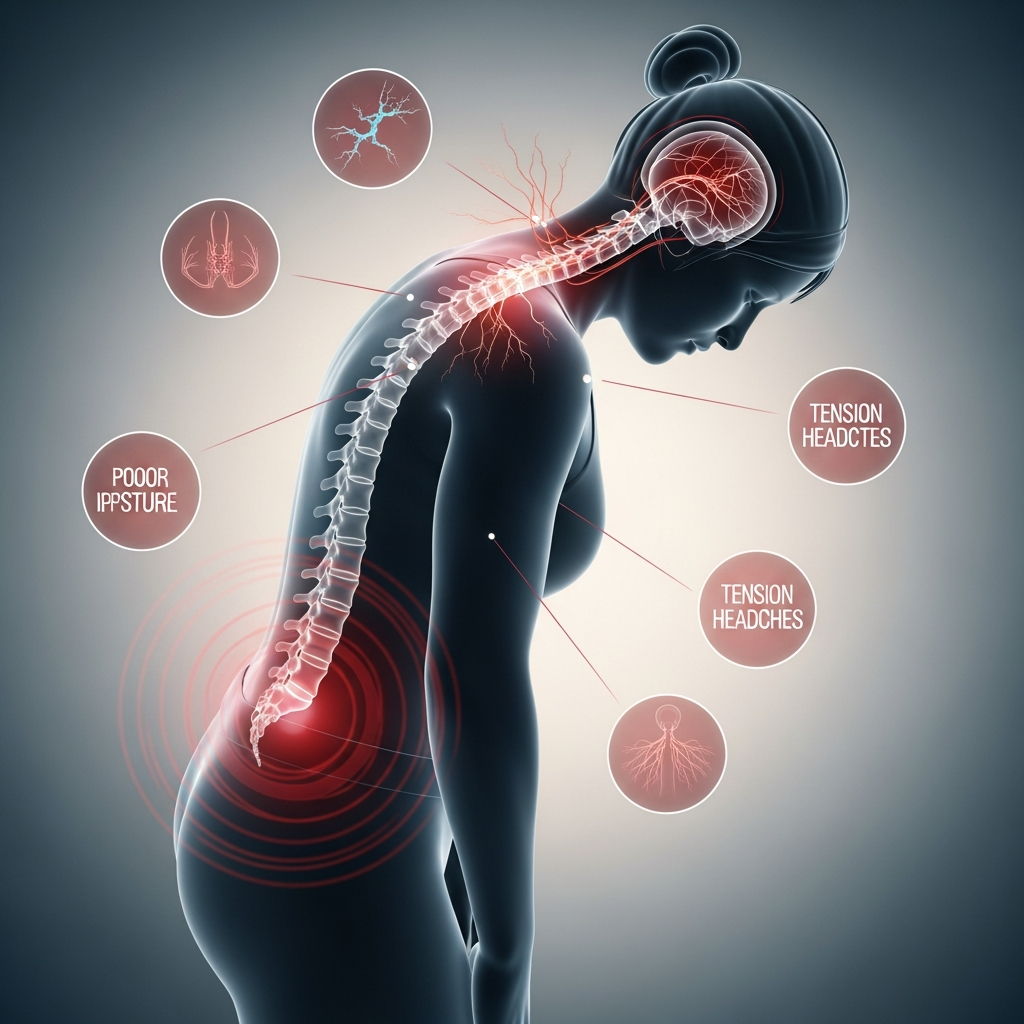
Hey there! Take a quick mental snapshot of yourself right now. Are you reading this on a phone, head bowed? Or perhaps hunched over a laptop, shoulders somewhere up around your ears? Maybe you’re slumped on a couch, feeling that familiar curve in your lower back. If any of this rings true, you’re not alone. In our modern world of screens, sedentary jobs, and constant forward focus, poor posture has become a silent, creeping norm.
But here’s the crucial thing to understand: posture is far more than just “sitting up straight to look attentive.” It is the very foundation upon which your health is built. Think of your body as a marvelously complex, interconnected structure. When that structure is in alignment—your bones stacked efficiently, your muscles balanced—everything works as nature intended. But when it’s off-kilter, the consequences ripple through your entire system, slowly, subtly, and sometimes painfully.
The narrative we often tell ourselves is that slouching is just a bad habit, maybe a bit unsightly. The truth is far more significant. Poor posture is a form of slow-motion damage, a daily grind on your body that can lead to a cascade of health issues far beyond a stiff neck. The good news? It’s also one of the most accessible and empowering things you can address. This isn’t about achieving robotic perfection; it’s about awareness, gentle correction, and giving your body the care it deserves to thrive for decades to come. So, let’s lean in (with a straight back, of course) and explore how your posture is talking to you, what it’s trying to say, and how you can lovingly answer back.
The Silent Language of Your Spine: What Poor Posture Really Is:
First, let’s define our terms. Good posture isn’t about standing stiff as a soldier. It’s a state of muscular and skeletal balance where the body is aligned with gravity, whether you’re moving (dynamic posture) or still (static posture). In this optimal state, the curves of your spine—the gentle inward curve at your neck (cervical), outward curve in your upper back (thoracic), and inward curve in your lower back (lumbar)—are in their natural, shock-absorbing positions.
Poor posture, then, is any significant deviation from this neutral alignment. The most common modern offenders are:
· Forward Head Posture (aka “Text Neck”): The head juts forward, sometimes by several inches. For every inch forward, the effective weight of your head on your spine doubles. This is the hallmark of the digital age.
· Rounded Shoulders (Kyphosis): The shoulders roll inward and forward, collapsing the chest. This is the companion to forward head posture, often seen at desks and steering wheels.
· Anterior Pelvic Tilt (“Swayback”): The pelvis tilts forward, creating an exaggerated arch in the lower back and often a protruding stomach. This is common with prolonged standing or sitting with weak core muscles.
· The Full “C-Curve” Slump: A total collapse of the body, where the back forms a single, long curve, abandoning all its natural S-shape support.
These positions might feel comfortable in the moment because they allow certain overused, tight muscles (like your chest and hip flexors) to rest, while forcing other, weaker muscles (like your upper back and glutes) to switch off. But this “comfort” is an illusion—a temporary truce that leads to a long-term war within your body.
The Slow Creep of Consequences: How Poor Posture Damages Your Health:
The damage from poor posture is rarely sudden. It’s the physiological equivalent of water dripping on stone, wearing it away day by day. Here’s where those drops are falling:
1. The Musculoskeletal Mayhem: Pain, Imbalance, and Wear & Tear
This is the most direct and felt consequence.
· Chronic Pain: Tight muscles (like neck, upper traps, and hip flexors) become overworked and painful. Weak, inhibited muscles (like the deep neck flexors, mid-back rhomboids, and glutes) lead to instability. The result? A predictable cycle of neck pain, shoulder tension, upper and lower back pain, and even jaw (TMJ) issues.
· Joint Degeneration and Reduced Mobility: When your spine and joints are not aligned, force is distributed unevenly. This can accelerate the wear and tear of spinal discs (potentially leading to herniation), and contribute to osteoarthritis in the facet joints of the spine and even in the hips and knees. Your range of motion gradually shrinks.
· The Headache Connection: Forward head posture puts immense strain on the suboccipital muscles at the base of your skull. These tiny muscles, when in constant spasm, are a primary trigger for tension headaches and migraines.
2. The Hidden Internal Impact: When Your Organs Get Squished
Your skeleton is the cage that protects and provides space for your vital systems.Compromise the cage, and you compromise what’s inside.
· Compromised Breathing: A slumped, rounded posture literally collapses your chest cavity. This restricts the full excursion of your diaphragm, the primary breathing muscle. You shift to shallow, inefficient “chest breathing,” reducing oxygen intake and potentially affecting energy levels, focus, and even anxiety.
· Digestive Dysfunction: Slouching compresses your abdominal organs. Imagine kinking a hose. This can hinder peristalsis (the wave-like motion that moves food), contributing to issues like acid reflux, heartburn, bloating, and constipation.
· Circulatory Constriction: Poor alignment can impede optimal blood flow, especially through major vessels. It can also increase pressure on the heart and lungs as they work in a confined space.
3. The Energy and Mood Drain: The Posture-Mind Loop
Your posture isn’t just a physical state;it’s a two-way street with your psychology.
· Energy Expenditure: Holding a body in misalignment is exhausting. Your muscles are working in inefficient, compensatory patterns, burning energy just to keep you upright against gravity. This can lead to that pervasive, unexplained fatigue many feel by mid-day.
· Mood and Confidence: Groundbreaking research by social psychologists like Amy Cuddy has shown that our body language affects how we feel. A slumped, closed posture can increase cortisol (the stress hormone) and decrease testosterone, making us feel more anxious, passive, and less resilient. Conversely, adopting an upright, open “power pose” can have the opposite effect. You’re not just sitting sadly because you’re down; you might be feeling down because of how you’re sitting.
4. The Long-Term Trajectory: A Future of Limitations
If left unchecked,the slow creep becomes a steady decline. The muscle imbalances become permanent. The joint degeneration progresses. The pain becomes a constant companion. What starts as an occasional twinge in your 30s can become debilitating chronic pain in your 50s and 60s, severely limiting your ability to enjoy life, play with grandchildren, travel, or simply move without thinking about it.
It sounds daunting, but please, don’t feel discouraged. This knowledge is power. Because every single one of these negative pathways can be slowed, halted, and often reversed. You are not a prisoner to your current posture. You are its architect, and you can start rebuilding today.
The Roadmap to Reclamation: How to Fix Your Posture (With Kindness!):
Fixing posture is a journey of re-education, not a quick fix. It’s about building new habits, strengthening forgotten muscles, and releasing overused ones. Ditch the judgment. Approach this not with military rigor, but with the curiosity and care of someone rediscovering how their amazing body works.
Phase 1: Cultivating Awareness – The Foundation of Change
You can’t change what you don’t notice. The goal here is to break the autopilot of slouching.
· Environment Audit: Set up your workspace for success. Your feet should be flat on the floor, knees at hip level or slightly below. Your screen should be at eye level (use a stand or books!). Your elbows should be at 90-110 degrees, with wrists straight. The top of your monitor should be at or slightly below eye level.
· The “Posture Check” Prompt: Use everyday cues as reminders. Every time you send a text, check a notification, take a sip of water, or wait at a red light, let that be your cue to do a quick body scan: Ears over shoulders, shoulders over hips. Gently draw your shoulder blades down and back, as if you’re tucking them into your back pockets. Imagine a string pulling the crown of your head towards the ceiling.
· Wall Test: Stand with your back against a wall. Your heels, butt, shoulder blades, and the back of your head should lightly touch the wall. There should be a slight, natural curve in your lower back (about enough space to slide your hand through). Practice this feeling of alignment.
Phase 2: The Movement Medicine – Stretch and Strengthen
This is the active repair work. Aim for little and often—5-10 minutes daily is far better than an hour once a week.
To RELEASE Tight Muscles (Do these daily):
1. Doorway Chest Stretch: Stand in a doorway, place forearms on the frame with elbows at 90 degrees, and step forward until you feel a stretch across your chest. Hold for 30 seconds. Breathe.
2. Neck and Trap Release: For forward head posture, gently tuck your chin straight back, creating a “double chin.” Hold for 5 seconds, release. Repeat 10 times. Follow with gentle ear-to-shoulder stretches.
3. Hip Flexor Lunge Stretch: Kneel on one knee (use a cushion), tuck your pelvis under, and gently lean forward into the hip of the back leg. Feel the stretch in the front of that hip. Hold for 30 seconds per side.
4. Child’s Pose: A wonderful, full-body release for the back. Kneel on the floor, sit back on your heels, and fold forward, resting your forehead on the ground and arms outstretched. Breathe deeply into your back.
To STRENGTHEN Weak Muscles (Aim for 3-4 times a week):
1. Rows for Your Upper Back: Using a resistance band anchored in front of you, or even just mimicking the motion, pull your elbows back, squeezing your shoulder blades together. This fights rounded shoulders. 2 sets of 12-15.
2. Bridges for Your Glutes and Hamstrings: Lie on your back, knees bent, feet flat. Lift your hips towards the ceiling, squeezing your glutes at the top. This counteracts anterior pelvic tilt. 2 sets of 15.
3. Planks for Your Core: Start on your forearms and toes, body in a straight line from head to heels. Engage your entire core, not just your abs. Hold for 20-60 seconds. This builds the foundational stability your spine craves.
4. Chin Tucks (Strengthening Version): Lying on your back, perform the same chin tuck, holding for a few seconds. This strengthens the deep neck flexors that support your head.
Phase 3: Integrating Habits for Sustainable Change
· Move Frequently: Set a timer for every 30 minutes. Stand up, walk for two minutes, do a quick stretch. This is non-negotiable. Sedentary is the enemy.
· Reinforce with Other Activities: Consider practices that inherently teach body awareness and alignment. Yoga, Pilates, Tai Chi, and swimming are phenomenal complements. Even strength training with proper form reinforces good postural patterns.
· Mind Your Sleep Posture: Your bed matters. Side sleepers should use a pillow that keeps their head neutral with their spine (not propped up). A pillow between the knees can help. Back sleepers need a thinner pillow. Stomach sleeping is the most stressful for the neck and spine—try to transition away from it.
· Carry Yourself Mindfully: Be aware of how you carry bags. Switch sides frequently, or better yet, use a backpack with two straps. Avoid cradling your phone between your ear and shoulder.
A Final Word of Encouragement
Your journey to better posture is a profound act of self-care. It’s not about vanity; it’s about claiming your vitality. There will be days you forget, days you slip back into old habits. That’s perfectly okay. This isn’t about perfection; it’s about progression. Each time you notice your slouch and gently correct it, you’re strengthening a new neural pathway. Each stretch is a gift of release to a tight muscle. Each strengthening exercise is a vote of confidence for a weaker one.
Listen to your body’s whispers—the tightness, the fatigue—so it doesn’t have to scream in pain later. You are embarking on a journey that will not only alleviate pain and prevent injury but will also boost your energy, your breathing, your digestion, and even your mood. You are rebuilding your foundation for a more active, vibrant, and pain-free life.
So take a deep, full breath right now. Feel your spine lengthen. Gently roll your shoulders back and down. Smile. You’ve just taken the first, most important step. Now, go forth and carry yourself through the world with the strength and grace you deserve. You’ve got this