

PORT HARCOURT / ABUJA
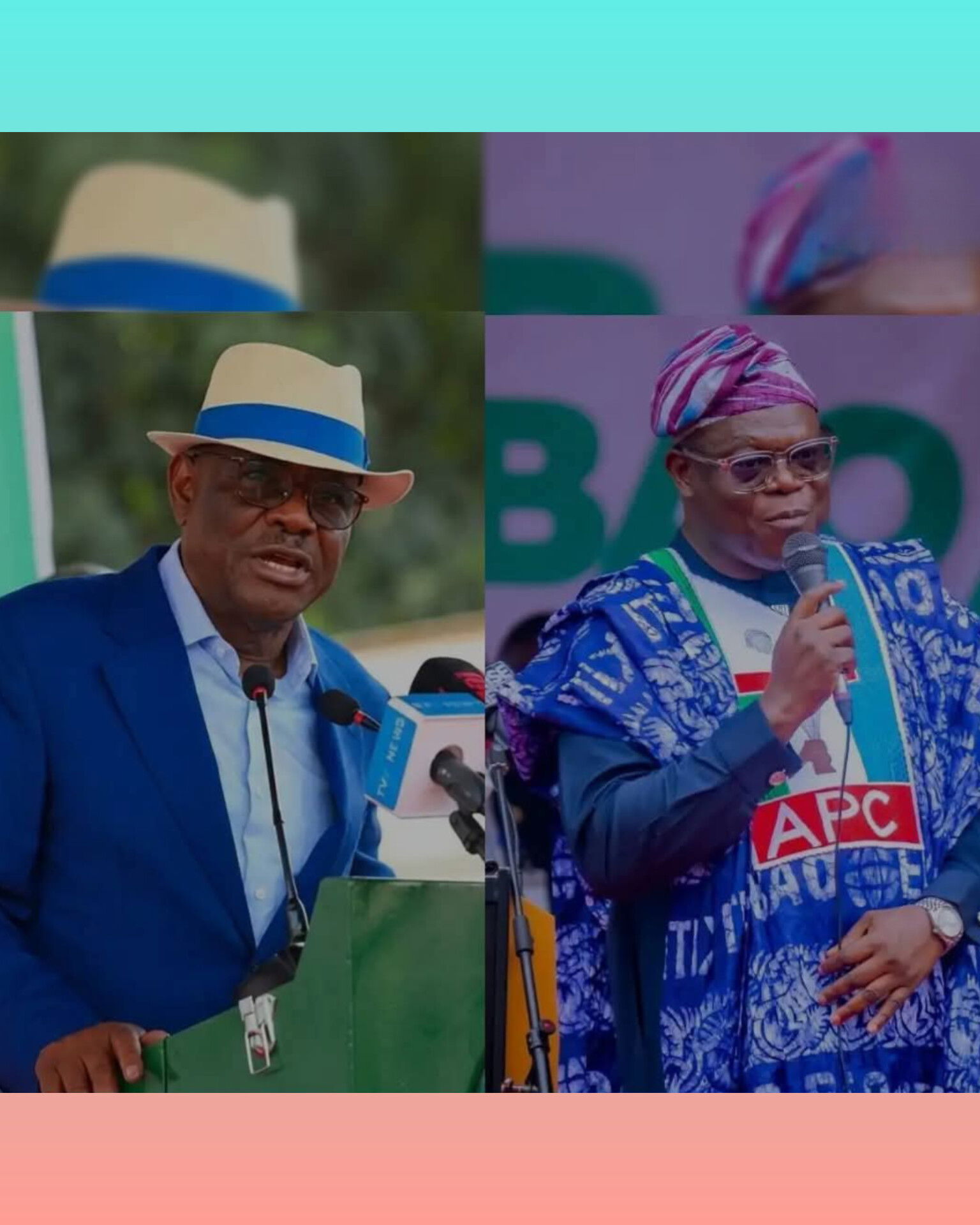
In a dramatic escalation of Nigeria’s simmering political tensions, a blistering crossfire has erupted between the Minister of the Federal Capital Territory (FCT), Mr. Nyesom Wike, and the National Secretary of the ruling All Progressives Congress (APC), Senator Ajibola Basiru, over the political soul of Rivers State, the sanctity of party affiliation, and the propriety of a sitting minister’s focus. The exchange, laden with accusations of interference, opportunism, and constitutional overreach, threatens to widen fissures within the governing structures at both state and national levels, casting a stark light on the complex, often treacherous interplay of loyalty, power, and territorial control in the nation’s polity.
The genesis of the conflict lies in recent public remarks made by Senator Basiru, the APC’s chief scribe, who offered support for the embattled Governor of Rivers State, Sir Siminalayi Fubara. Fubara, a protégé of Wike, has been enmeshed in a protracted and highly publicised political war with the Rivers State chapter of the APC, which is heavily influenced by Wike’s longstanding rival and former governor, Rotimi Amaechi. Basiru’s vocal alignment with Fubara was perceived in many quarters, and evidently in Wike’s camp, as a significant and potentially destabilising external endorsement in the volatile Rivers political arena.
WIKE’S FIRING LINE: A DECLARATION OF POLITICAL SOVEREIGNTY:
Responding with characteristic force, Nyesom Wike, the former Governor of Rivers who now presides over the nation’s capital, issued a stern and unambiguous warning to the APC national secretary. Addressing a charged gathering of supporters in Oyigbo Local Government Area of Rivers State on Monday, Wike transformed the political rally into a bastion of defiance.
“Let me warn the National Secretary of the APC, Senator Ajibola Basiru, to stay clear of Rivers State politics,” Wike declared, his voice echoing with the authority of a man who still considers the oil-rich South-South state his undisputed political fiefdom. “Rivers State is not a playground for political tourists or meddlers from other states. We have our own internal mechanisms and political culture. Those from outside should focus on developing their own states.”
Wike’s statement was more than a personal rebuke; it was a broader declaration of political sovereignty. He framed Basiru’s intervention as an affront to the collective dignity of Rivers people, appealing to a deep-seated sentiment of local resistance against external domination—a theme that resonates powerfully in the Niger Delta region. The FCT Minister painted a picture of Rivers as a self-contained political ecosystem, capable of managing its affairs without unsolicited commentary from national party officials hailing from Osun State, Basiru’s political base.
The warning, however, carried a sharper, more consequential edge. Wike subtly linked the political peace in Rivers, and by extension the support of its political leaders, to the stability of the federal government. “Let no one take for granted the massive support that the leaders and people of Rivers State gave to President Bola Ahmed Tinubu during the elections,” he cautioned. This statement was widely interpreted as a veiled reminder of his own pivotal role in delivering Rivers State to President Tinubu in the 2023 presidential election—a feat achieved against the wishes of the state’s formal APC structure. It was a clear signal that the support he engineered was not unconditional and could be jeopardised by perceived attacks on his political territory or authority from within the very party that benefitted from his crossover support.
Wike further dismissed Basiru’s motivations, insinuating that the APC Secretary’s newfound interest in Rivers was fuelled by mercenary instincts. Without naming a specific figure, he alluded to the state’s substantial financial resources, famously quipping in his typical abrasive style, “They see the N600 billion in our coffers and their eyes have become clear. They want to come and feast where they did not sow. We will not allow that.”
BASIRU’S COUNTER-ASSAULT: A CALL FOR RESIGNATION AND A DEFENCE OF PRINCIPLE:
Senator Ajibola Basiru, a Professor of Law and former Senate spokesman known for his legal precision and doctrinal approach to party politics, did not retreat into silence. In a sharply worded statement released also on Monday, he launched a formidable counter-offensive, targeting not just Wike’s comments but his very right to make them while holding a federal executive office.
Basiru’s response was a two-pronged attack: one constitutional, the other personal. Firstly, he challenged Wike’s locus standi to comment on or interfere in the internal affairs of the APC. “It is the height of irony and political rascality for the Minister of the FCT, who is not a member of the All Progressives Congress, to be dictating to the party on who to associate with or what positions to take regarding any state of the federation,” Basiru stated. He erected a firm boundary around party membership, asserting that until Wike officially defects from the Peoples Democratic Party (PDP)—on whose platform he was twice elected governor—and registers as an APC member, he remains an outsider with no right to influence APC decisions or chastise its officials.
The second and more explosive part of Basiru’s statement was a direct call for Wike’s resignation. “Given Mr. Wike’s apparent and obsessive preoccupation with the politics of Rivers State and his constant forays into APC affairs, it is only appropriate that he resigns his position as Minister of the FCT,” Basiru asserted. He framed Wike’s conduct as a dereliction of duty, arguing that the minister’s focus should be solely on the daunting task of developing Abuja, not on micro-managing political battles hundreds of kilometres away in Port Harcourt. “The good people of Nigeria, particularly residents of the FCT, deserve a minister who is fully committed to addressing the pressing issues of infrastructure, security, and urban planning in the capital city, not one who is perpetually entangled in the politics of his home state.”
In a pointed rebuttal to Wike’s accusation of financial opportunism, Basiru mounted a defence of his own integrity and principle. “My comments on Rivers State were made based on constitutional and democratic principles, not on any pecuniary considerations,” he stated. “To suggest that I, Ajibola Basiru, am motivated by the resources of Rivers State is not only false but deeply insulting. I have built my political career on consistency and principle. I am not an opportunist. My support for Governor Fubara, where and when expressed, is rooted in a belief in the constitutional order and the need to respect the mandate freely given to him by the people of Rivers State, regardless of the ongoing political disagreements.”
ANATOMY OF A FEUD: BEYOND THE PERSONALITIES:
While the clash between Wike and Basiru is intensely personal, it is symptomatic of larger, systemic tensions shaking the foundations of Nigeria’s political architecture.
1. The Crisis of Party Identity and Membership: At its core, this feud highlights the blurred lines and existential crisis facing Nigerian political parties. Wike, a PDP stalwart who worked for an APC presidential candidate, now holds a top cabinet position in an APC-led government while actively opposing the APC in his home state. Basiru’s retort underscores the frustration of party purists who see such fluidity as corrosive to ideological coherence and discipline. It raises fundamental questions: What does party membership mean? Can one reap the benefits of a party at the national level while undermining it at the sub-national level?
2. The “Minister-Godfather” Dichotomy: Wike’s dual role as a serving federal minister and the de facto political godfather of Rivers State presents a constitutional and ethical quandary. Basiru’s call for resignation taps into a growing national debate about whether such roles are compatible. Critics argue that Wike cannot effectively oversee the FCT—a neutral, national territory—while simultaneously being a partisan combatant in a volatile state conflict. His supporters, however, see it as a testament to his political prowess and a legitimate balancing act between national service and local influence.
3. The Rivers State Political Theatre: Rivers State remains Nigeria’s most consequential political battleground outside Abuja. The struggle between the Wike/Fubara axis and the Amaechi/APC faction is a proxy war for control of immense financial resources, patronage networks, and strategic political influence in the Niger Delta. Basiru’s entry, ostensibly on principle, is seen by the Wike camp as an attempt by a faction of the national APC to re-assert control over the state’s politics, potentially at the expense of Wike’s carefully constructed influence.
4. The Tinubu Calculus: Hovering over this conflict is the figure of President Bola Tinubu. Both Wike and Basiru are, in different ways, key to his political project. Wike is a valuable ally whose cross-party support was crucial for victory. Basiru is a key official of the president’s own party, responsible for its administrative coherence. The president now faces a delicate balancing act. Will he rein in his party secretary to placate a powerful minister? Or will he assert party supremacy, risking the alienation of a maverick but influential supporter? The silence from the Presidential Villa is, for now, deafening.
5. The Federalism Question: Wike’s rhetoric of “outsiders staying away” speaks to the perennial tensions in Nigeria’s federal system. While the constitution guarantees freedom of political association and expression, there is a strong undercurrent of sub-national resentment against perceived interference from the centre or from politicians of other states. This clash thus becomes a microcosm of the debate over the limits of national party authority versus state-level political autonomy.
REACTIONS AND FALLOUT: A NATION WATCHES:
The political landscape is rife with reactions. In Rivers State, Wike’s supporters have hailed his stance as a bold defence of the state’s honour. “Our leader has spoken. Rivers is not a colony of anyone,” declared a chieftain of the PDP in Port Harcourt. Meanwhile, the state APC chapter, loyal to Amaechi, has cautiously welcomed Basiru’s principle-based stance but remains wary of any move that might legitimise Fubara’s administration, which they still contest.
Political analysts are divided. Some see Basiru’s position as legally sound and ethically necessary to preserve the integrity of party politics and ministerial responsibility. “Wike cannot have his cake and eat it,” argued Dr. Sam Amadi, a political analyst. “He must choose between being a full-time minister or a full-time godfather. The two roles, executed with such public vigour, are in fundamental conflict.”
Others view Wike’s position as a realistic reflection of Nigeria’s political dynamics, where influence is territorial and fluid. “To ask Wike to ignore Rivers politics is to ask a fish to live out of water,” countered Prof. Abiodun Adeniyi. “His political relevance, which he leverages even for his federal role, is rooted in Rivers. Basiru’s intervention, however principled, is politically naive and risks destabilising the delicate peace in the Niger Delta.”
The media and civil society have largely focused on the call for resignation, sparking debates about the code of conduct for public officers and the need for clearer ethical guidelines to prevent the conflation of national office with local political warfare.
LOOKING AHEAD: IMPLICATIONS FOR GOVERNANCE AND POLITICS:
As the dust from this initial exchange settles, the implications are profound and far-reaching.
For the APC, this public spat between a key national officer and a powerful minister who is a de facto ally exposes deep internal contradictions. It threatens party discipline and projects an image of disorder at the highest levels. The party’s National Working Committee faces a test of its authority in managing this conflict.
For the Tinubu administration, the feud is an unwelcome distraction. It consumes political oxygen needed for governance and highlights the fragile nature of the coalition that brought it to power. How the President navigates this rift will signal his approach to managing the often-warring factions within his broad support base.
For Rivers State, the external dimension introduced by Basiru’s comments and Wike’s fierce response risks further polarising the political environment. It may internationalise the local conflict, drawing in more national actors and making a peaceful, internally-driven resolution more difficult.
For Nigerian democracy, this episode underscores the urgent need for institutional strengthening. The ambiguity around party membership, the lack of enforceable ethical codes for ministers engaged in partisan politics elsewhere, and the overwhelming focus on personalities over ideology continue to plague the political system.
In the final analysis, the Wike-Basiru clash is more than a war of words. It is a stark revelation of the fault lines in Nigeria’s political geography—where personal fiefdoms collide with party structures, where ministerial portfolios are wielded as extensions of local power, and where the lines between principle, opportunism, and territorial defence are perpetually blurred. As both men stand their ground, the nation watches, waiting to see whether this conflict will fizzle into another episode of political drama or ignite a broader conflagration that reshapes alliances and redefines the rules of engagement in the perilous game of Nigerian politics. The next move, undoubtedly, rests in the corridors of power in Abuja and the reaction, or lack thereof, from the President who holds the balance.