

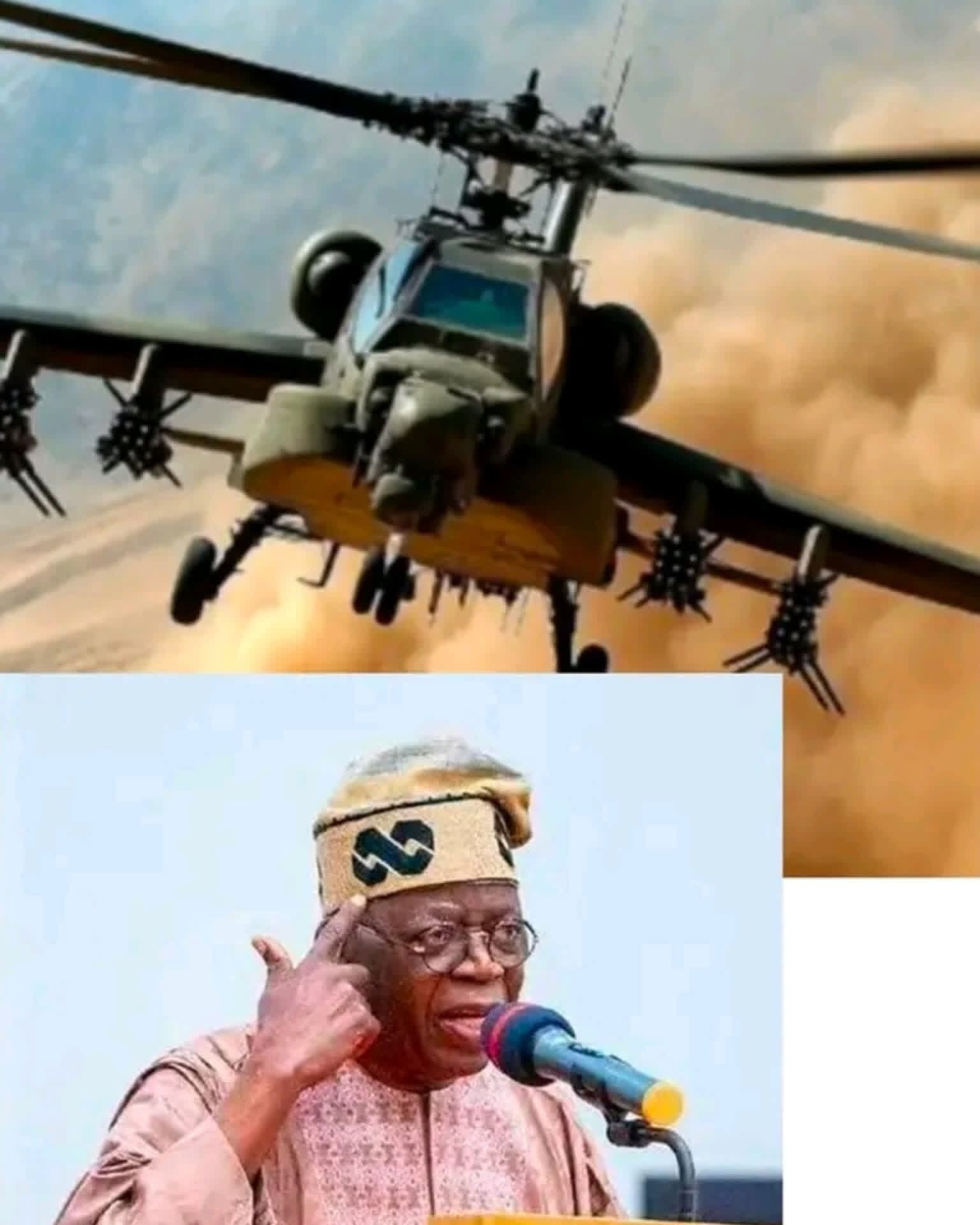
A Strategic Boost: Tinubu Announces Impending Arrival of U.S. Attack Helicopters to Fortify Nigeria’s Security
In a significant disclosure that underscores his administration’s frontline commitment to national security, President Bola Ahmed Tinubu has announced that four attack helicopters ordered by the Federal Government from the United States will soon arrive in Nigeria. The President made this revelation on Friday while receiving a delegation of the Christian Association of Nigeria (CAN), led by its President, Archbishop Daniel Okoh, at his Lagos residence. This announcement, made in the context of a dialogue with a pivotal religious and moral voice in the nation, is far more than a routine procurement update; it is a potent symbol of a strategic shift, a tangible investment in the tools of security, and a direct message of reassurance to a populace weary from the lingering shadows of insecurity.
The setting of this announcement is itself deeply symbolic. By sharing this critical military update during an audience with CAN, President Tinubu adeptly framed the security challenge not merely as a political or tactical issue, but as a fundamental matter of national moral imperative. The Christian Association of Nigeria, representing a vast swathe of the citizenry, has been a consistent voice advocating for the protection of all Nigerians, particularly those in vulnerable communities plagued by violence. Informing Archbishop Okoh and his delegation of this development signals an administration that is actively listening to the concerns of civil society and is keen to demonstrate that those concerns are being met with concrete action, not just rhetoric. It bridges the gap between the strategic command rooms and the pews, acknowledging that true security is a prerequisite for societal peace and harmony.
According to President Tinubu, the acquisition of these advanced aerial assets is a core component of "ongoing efforts to strengthen national security and boost the operational capacity of the country’s security forces." This statement reveals a multi-faceted strategic intent. Firstly, the deployment of attack helicopters represents a force multiplier for Nigeria’s military and air force. In tackling asymmetric threats from insurgent groups in the Northeast, armed bandits terrorizing the Northwest and North-Central, and militants in the Niger Delta, aerial mobility, surveillance, and precision strike capabilities are invaluable. Helicopters can rapidly respond to threats across difficult terrains, provide close air support to ground troops, conduct intelligence, surveillance, and reconnaissance (ISR) missions, and interdict the movement of adversaries. Their impending arrival suggests a focused effort to correct critical capability gaps that have, in the past, hampered swift and decisive responses to attacks.
Secondly, the sourcing of these helicopters from the United States is of considerable geopolitical and technical significance. It points to the continued and perhaps deepening of defense cooperation between the two nations. Procuring such platforms involves not just a financial transaction but also complex negotiations, trust, and ongoing partnerships for training, maintenance, and spare parts. This deal reinforces the strategic security relationship, suggesting U.S. confidence in the Tinubu administration’s security framework and its commitment to deploying these assets responsibly. The technology and training accompanying such American-made equipment will also serve to enhance the professionalism and operational standards of the Nigerian armed forces.
Beyond the hardware, President Tinubu leveraged this moment to deliver a broader message of assurance. He firmly declared that his administration "remains fully committed to tackling insecurity and protecting lives and property across the nation." This is a reaffirmation of the government’s most basic constitutional covenant with its people. However, he moved beyond generalities, stressing that the government is "taking deliberate steps to ensure peace, safety, and stability." The keyword here is "deliberate." It implies a move away from ad-hoc reactions towards a calculated, comprehensive security architecture where calculated acquisitions like these helicopters form one piece of a larger puzzle. This puzzle likely includes ongoing reforms in security agency coordination, enhanced intelligence gathering, investment in border control technology, and addressing the root causes of conflict through socio-economic initiatives.
The announcement, however, also arrives with an inherent set of public expectations and questions. Citizens will rightly want to see a direct correlation between the deployment of these new assets and a measurable improvement in security on the ground. The effectiveness of the helicopters will depend on seamless integration into existing operations, excellent maintenance to ensure availability, and most importantly, accurate, intelligence-driven deployment. There is also the perennial challenge of ensuring that enhanced military capability is exercised with utmost regard for human rights and collateral damage, a concern that groups like CAN often rightly highlight. The ultimate success of this investment will be judged not by the roar of the helicopters' engines but by the silence of guns in troubled communities and the restored sense of safety among Nigerians.
In conclusion, President Tinubu’s announcement of the imminent arrival of U.S. attack helicopters is a strategically timed and substantively important development. It serves as a diplomatic signal, a military enhancement, and a public reassurance all at once. While no single weapon system can singularly solve Nigeria’s complex security challenges, this procurement represents a critical infusion of capability into the nation’s security apparatus. When integrated into a broader, intelligent, and holistic security strategy that also addresses governance, justice, and economic disparities, such tools can be decisive in tilting the balance in favor of the state. As the nation awaits the arrival of these aircraft, the focus now shifts to the "deliberate steps" that must follow—their effective utilization, the continued nurturing of security force professionalism, and an unwavering commitment to the peace and stability that every Nigerian deserves. This move demonstrates that the Tinubu administration is investing in the hardware of security; the enduring test will be its fidelity in cultivating the software of trust, justice, and lasting peace. 🇳🇬✈️



