

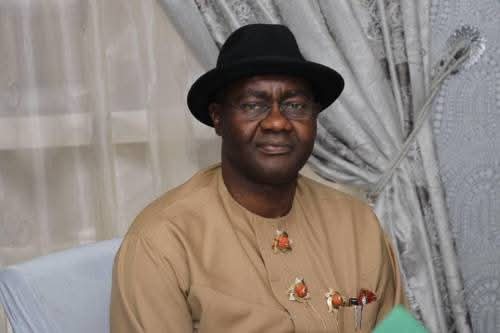
Port Harcourt, Rivers State. In a dramatic escalation of the political crisis engulfing Nigeria’s oil-rich Rivers State, Senator Magnus Abe, a seasoned political figure and former representative of Rivers South-East, has issued a stark and unequivocal warning to the state’s embattled Governor, Sir Siminalayi Fubara. The warning strikes at the heart of the simmering feud between Governor Fubara and his erstwhile political benefactor, the Federal Capital Territory (FCT) Minister, Mr. Nyesom Wike. Abe’s statement, laden with political metaphysics and a direct appeal to higher loyalties, frames the local conflict as a litmus test for allegiance to President Bola Ahmed Tinubu.
“You cannot claim to love and support President Bola Ahmed Tinubu and still be fighting and confronting his minister and one of his strongest allies,” Abe declared, in comments that have sent seismic waves through the already fractured political landscape of the Niger Delta. This declaration, made during an interview with journalists in Port Harcourt, transcends the typical rhetoric of intra-party squabbles. It posits a new, contentious political axiom: that loyalty to President Tinubu is indivisible from loyalty to Minister Wike, at least within the context of Rivers politics.
The Unfolding Crisis: A Chronology of Discord:
To understand the gravity of Abe’s intervention, one must revisit the genesis of the current impasse. The crisis, which has plunged governance in Rivers State into a near-paralysis, erupted into the open in late 2023. It pits Governor Siminalayi Fubara, who assumed office in May 2023 under the banner of the Peoples Democratic Party (PDP), against the political machinery of Nyesom Wike, the immediate past governor of the state and a figure whose influence extends far beyond the creeks of the Niger Delta.
Wike, now serving as the FCT Minister in President Tinubu’s All Progressives Congress (APC)-led administration, was instrumental in Fubara’s ascension. However, the relationship soured rapidly, with accusations of gubernatorial independence clashing against expectations of sustained political subservience. The conflict reached a fever pitch with a shocking attempt to impeach Governor Fubara by a faction of the State House of Assembly loyal to Wike. This move, perceived by many as a direct coup, triggered a series of retaliatory actions.
The state assembly complex was mysteriously set ablaze. The assembly itself split into two parallel bodies—one pro-Fubara, one pro-Wike—each conducting legislative business from separate locations. The political theatre reached its apex when a group of lawmakers, led by the Wike-loyalist Speaker, Martins Amaewhule, defected from the PDP to the APC. Governor Fubara, in a countermove, presented an appropriation bill to a handful of lawmakers supportive of his administration, who passed it within minutes, a move critics labelled as legislative farce.
President Tinubu, in a bid to stem the tide of anarchy in a state critical to the nation’s economic lifeline, intervened directly in December 2023. He brokered a peace deal, often referred to as the “8-Point Resolution,” which was signed by key actors including Fubara, Wike, and other stakeholders. The resolution demanded a cessation of hostilities, the withdrawal of all court cases, and the recognition of the leadership of the Martin Amaewhule-led assembly, among other points.
The Peace That Never Was: A Fractured Resolution:
The presidential intervention, initially hailed as a masterstroke, has proven to be a fragile ceasefire at best. While Governor Fubara has publicly expressed commitment to the peace accord, his actions have been interpreted by the Wike camp as tactical delays and subtle defiance. The pro-Wike legislators have repeatedly accused the governor of failing to implement critical aspects of the agreement, particularly the re-presentation of the state budget and the recognition of their committees.
It is within this climate of a cold war, masked by the veneer of a peace deal, that Magnus Abe’s comments land with calculated force. Abe, a former ally of Wike who later became a fierce political adversary during the battle for the APC governorship ticket in Rivers, now appears to be reading from a strategic script that aligns Wike’s interests inextricably with those of the Presidency.
Abe’s Doctrine: The Inseparability of Loyalty:
Senator Abe’s argument is built on a simple yet powerful political calculus. He portrays Nyesom Wike not merely as a former governor or a sitting minister, but as “one of [President Tinubu’s] strongest allies.” This characterization is significant. In the complex patronage networks of Nigerian politics, being a “strong ally” of the President confers a form of political sacrosanctity. To attack such an ally, Abe implies, is to indirectly challenge the authority and the political comfort of the President himself.
“The President has intervened in the crisis in Rivers State, and everyone who claims to respect and love the President should respect his judgment and his decisions,” Abe stated, framing the issue as one of obedience to presidential authority. He continued, “Minister Wike is serving this country as minister of the FCT. He was appointed by the President… If you indeed love the President, you cannot be fighting his minister.”
This formulation cleverly shifts the narrative. The conflict is no longer just a local Rivers affair about governance styles, resource control, or personal ambitions. It is reinterpreted as a test of loyalty to the national leader. By this logic, Governor Fubara’s continued resistance or perceived insubordination towards Wike is re-cast as disloyalty to President Tinubu. It is a classic political jujitsu, using the overarching authority of the Presidency to constrain a subordinate state actor.
Political Calculations and Realignments:
Analysts observing the scene are dissecting Abe’s motives with intense scrutiny. Magnus Abe is a veteran of the Rivers political wars. His own journey has seen him clash with Wike, operate within the APC, and navigate the treacherous waters of state politics. His current alignment with the pro-Wike narrative suggests a significant realignment, possibly aimed at positioning himself within the broader Tinubu-Wike political axis ahead of future electoral cycles.
“What Senator Abe has done is to articulate the unspoken rule of the current political moment in Rivers,” explains Dr. Ibiye Briggs, a political scientist at the University of Port Harcourt. “The Wike faction has consistently tried to nationalize the crisis, to bring the weight of the federal might to bear on a local dispute. Abe’s statement is the clearest public enunciation of that strategy. It’s a warning to Fubara and his supporters: this is no longer just about you and Wike; you are now potentially on a collision course with the Presidency.”
For Governor Fubara, this presents a profound dilemma. Capitulating fully to the demands of the Wike camp could mean surrendering the constitutional authority of his office and becoming a puppet governor. However, continuing a path of resistance now carries the newly framed risk of being labelled an enemy of the President’s peace and, by extension, the President himself—a perilous position for any governor, especially one whose state’s allocations and federal projects are controlled from Abuja.
The Silence from Abuja and the Governor’s Gambit:
Notably, the Presidency has maintained a studied silence following Abe’s provocative declaration. This silence is being interpreted in various ways. Some see it as tacit endorsement, allowing surrogates like Abe to voice positions too delicate for the Villa to state officially. Others believe it reflects a desire by President Tinubu to remain above the fray, allowing his initial resolution to stand as his sole intervention.
Governor Fubara, for his part, has adopted a public posture of calm dedication to governance. In recent weeks, he has embarked on project inspections and made statements focusing on development and the welfare of Rivers people. His spokespersons have reiterated his commitment to the presidential peace pact. However, this surface calm belies the raging undercurrents. The governor’s camp privately views Abe’s comments as part of a coordinated psychological and political offensive designed to box him into a corner.
“The governor is focused on delivering dividends of democracy,” a close aide to Governor Fubara, who spoke on condition of anonymity, stated. “He respects the President and the peace accord. However, the interpretation of that accord cannot be a one-way street that demands the surrender of a mandate freely given by the people of Rivers State. Loyalty to the President does not equate to subservience to another individual.”
Implications for Democracy and Governance:
Beyond the personalities involved, the crisis and statements like Abe’s raise fundamental questions about the nature of Nigeria’s democracy. Critics argue that the “Abe Doctrine” undermines the principles of federalism and the autonomy of state institutions. If a state governor’s loyalty to the President is measured by his deference to a federal minister—who is also a local political rival—then the concept of subnational independence is severely compromised.
“It sets a dangerous precedent,” warns Barrister Celestine Dike, a constitutional lawyer in Port Harcourt. “The office of the state governor is created by the constitution, not by presidential fiat or ministerial affiliation. To suggest that a governor must acquiesce to a minister, who is his predecessor, in order to prove loyalty to the President, is to subordinate constitutional order to political convenience. It is a recipe for instability.”
Furthermore, the ongoing crisis has had a tangible impact on governance. Legislative functions are in disarray, with crucial oversight and lawmaking responsibilities stalled. The atmosphere of uncertainty has the potential to dampen investor confidence in a state that is the hub of the nation’s hydrocarbon industry. The ordinary citizens of Rivers State, caught in the crossfire, watch as vital debates about infrastructure, education, and healthcare are sidelined by relentless political maneuvering.
The Road Ahead: An Impasse with National Repercussions:
As the standoff continues, the future appears fraught with uncertainty. Several scenarios are plausible. The first is a forced reconciliation, where sustained pressure from the federal axis compels Governor Fubara to fully implement the peace accord on terms favourable to the Wike camp, effectively neutralizing his governorship.
The second is a protracted stalemate, where Fubara continues his strategy of tactical compliance mixed with quiet resistance, hoping to outlast the pressure or for a shift in the national political calculus that weakens Wike’s position within the Tinubu administration.
A third, more explosive scenario, involves a total breakdown, leading to a declaration of a state of emergency—a move that would be deeply controversial and could ignite widespread unrest in the volatile Niger Delta region.
Senator Magnus Abe’s intervention has undoubtedly raised the stakes. By explicitly linking the fate of Siminalayi Fubara to his perceived loyalty towards Bola Tinubu through the prism of Nyesom Wike, he has transformed a regional political feud into a national loyalty test. The message to Governor Fubara and to all political observers is clear: in the high-stakes game of Nigerian politics, local ambitions must ultimately bow to the realities of federal power and the intricate web of alliances that sustain it.
The coming weeks will reveal whether Governor Fubara will navigate this treacherous terrain to reclaim his political agency or whether the Abe Doctrine will become the new, unwritten rule of political survival in the Rivers of today—and perhaps, for the Nigeria of tomorrow. The peace of the Niger Delta, and the integrity of Nigeria’s federal structure, may well hang in the balance.