

The Political Chessboard of Rivers State: Wike’s Declaration and Nigeria’s Shifting Power Dynamics
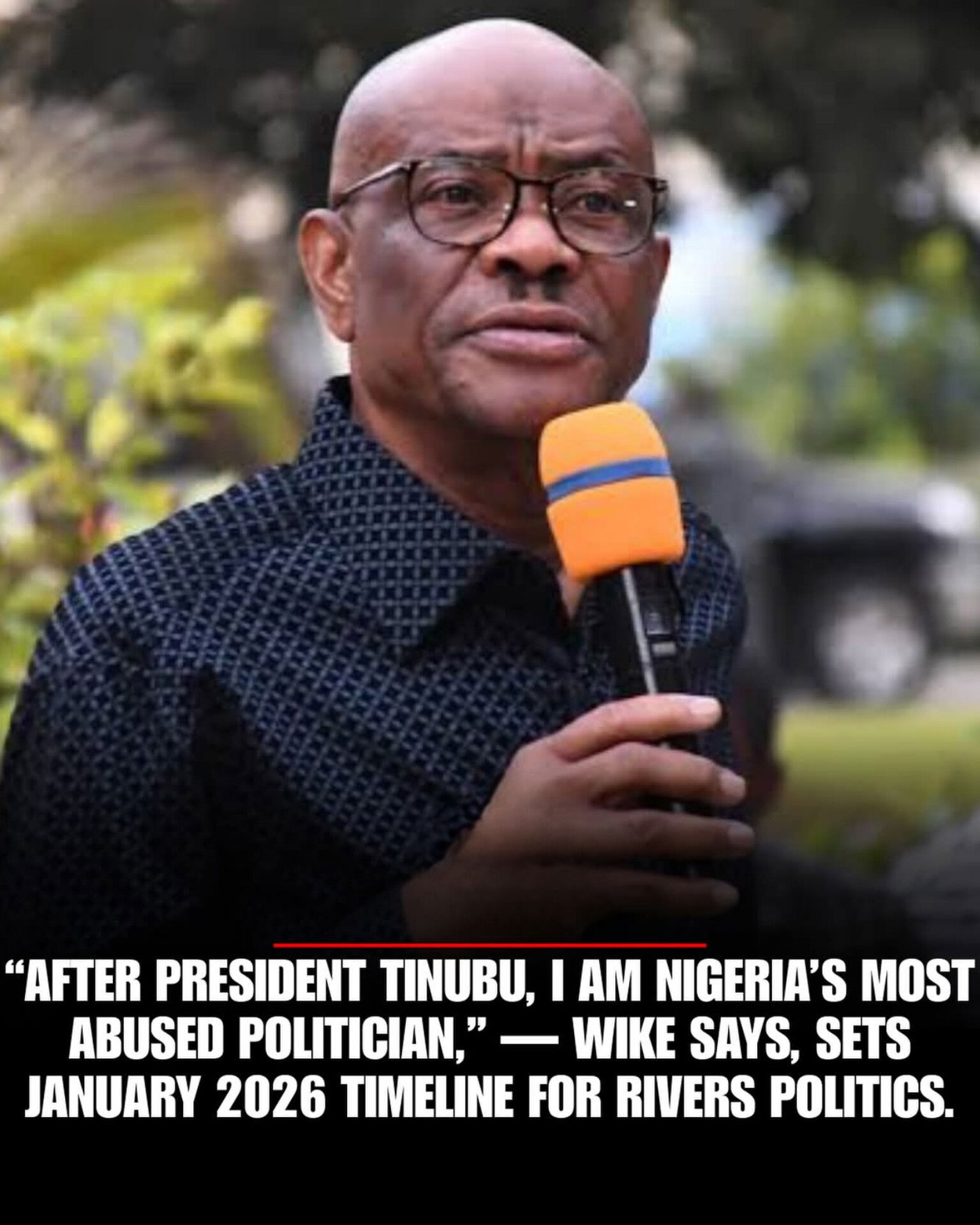
In the charged atmosphere of a thanksgiving service in Ahoada East, Rivers State, a pronouncement was made that reverberated far beyond the church walls. Nyesom Wike, the Minister of the Federal Capital Territory and the undisputed political architect of Rivers State, formally drew the battle lines for the future. His declaration that political activities in the oil-rich state would commence in January 2026 was not merely a calendar update; it was a meticulously timed political signal, a cannon shot across the bow of his adversaries, and a stark reminder of the complex, often volatile, equations that define Nigerian politics. Coupled with his self-description as “the most abused politician in Nigeria after President Bola Tinubu,” Wike’s speech offers a profound lens into themes of loyalty, betrayal, power consolidation, and the high-stakes preparations for the next electoral cycle.
Wike’s choice of venue and framing is quintessentially Nigerian political theatre. The thanksgiving service, a common feature blending faith, gratitude, and political mobilization, provided a veneer of moral authority and grassroots connection. Here, before his people, he transformed from a federal minister into the “Ikwerre Lion,” the local champion. By pegging the start of political activities to January 2026, he effectively seizes the initiative. In a political landscape where early birdcatching is paramount, this announcement serves as a clarion call to his vast network of supporters, allies, and foot soldiers to begin mobilization. It is a deliberate attempt to frame the narrative, control the tempo, and force all other actors—most notably his successor-turned-principal-opponent, Governor Siminalayi Fubara—to react to his timeline. This move underscores a fundamental truth in Nigerian politics: formal election dates are merely the finale; the real war is waged in the years prior, in the subtle alignments, resource deployment, and psychological positioning.
The heart of Wike’s address, however, was a masterclass in political messaging, built on a triad of loyalty, victimhood, and defiance. His unwavering proclamation of loyalty to President Bola Tinubu is strategic on multiple levels. First, it solidifies his position within the national ruling alliance, the All Progressives Congress (APC), despite his roots in the opposition Peoples Democratic Party (PDP). In the intricate “spoils” system of Nigerian politics, demonstrating unshakeable loyalty to the center is crucial for maintaining influence and securing federal benefits for one’s constituency—and oneself. Second, by praising Rivers residents for supporting Tinubu in 2023, he performs a dual act: he credits himself for delivering the state’s vote (a point of contention), and he subtly positions himself as the rightful conduit between Rivers State and the Presidency, thereby undermining Governor Fubara’s executive authority.
This proclamation of loyalty is intrinsically tied to his portrait of himself as the nation’s premier political victim. Claiming the title of “the most abused politician” after Tinubu is a calculated appeal for sympathy and a robust defensive gambit. It frames all criticism, opposition, and investigative scrutiny not as legitimate political contestation, but as persecution born of jealousy and betrayal. Wike roots this victimhood in a principle he presents as sacrosanct: the inviolability of political agreements. His warning that attacks stem from his “refusal to break political agreements” is a thinly veiled reference to the escalating crisis in Rivers State, widely interpreted as a fallout from perceived breaches in the political understanding that led to Fubara’s ascension. By positioning himself as the custodian of political honor, he transforms a bare-knuckle power struggle into a moral crusade, rallying his base around a narrative of steadfastness against treacherous forces.
The warning that his camp “would not be taken for granted” is the iron fist within the velvet glove of loyalty and victimhood. It is a direct message to multiple audiences. To President Tinubu and the APC national leadership, it is a reminder that Wike’s bloc is a powerful force that expects due recognition and reward in the 2027 calculations. To his opponents within and outside Rivers, it is a threat of formidable retaliation. To his own followers, it is a rallying cry to prepare for war. This defiance reveals the core of Wike’s political philosophy: power is respected only when it is exercised without apology and defended without quarter. His entire political career has been built on this premise, and his current federal role has done little to diminish his pugilistic, domineering approach to state politics.
The implications of this declaration are vast and multifaceted. For Rivers State, it promises a protracted period of intense political warfare, likely overshadowing governance and deepening the existing rift between the state government and the federal structure represented by Wike. The state’s resources and administrative machinery risk being entangled in this feud, with dire consequences for development and public welfare. For the APC, Wike’s move highlights both the strength and the fragility of its big-tent alliance. It gains a formidable strategist and mobilizer, but one whose primary loyalty is to his own political empire, potentially creating centrifugal tensions within the party. For Nigerian democracy, the spectacle underscores the personalization and militarization of politics, where institutions are weaker than individual “Godfathers,” and electoral cycles are perpetual campaigns of attrition.
In essence, Nyesom Wike’s Ahoada declaration is a masterstroke of political positioning. He has successfully set the clock for the 2027 elections in his home domain, painted himself as both a loyal lieutenant and a persecuted hero, and issued a stark warning to friend and foe alike. He understands that in the Nigerian political arena, silence is often misconstrued as weakness. By speaking now, loudly and clearly, he has reclaimed the narrative, solidified his base, and thrown down the gauntlet. The message is unambiguous: the battle for the soul and resources of Rivers State is open, and he intends to fight it on his own terms. As January 2026 approaches, the political temperature in the Niger Delta will only rise, with Wike firmly at the center of the storm, proving once again that in the calculus of power, he remains one of Nigeria’s most consequential and uncompromising calculators.