

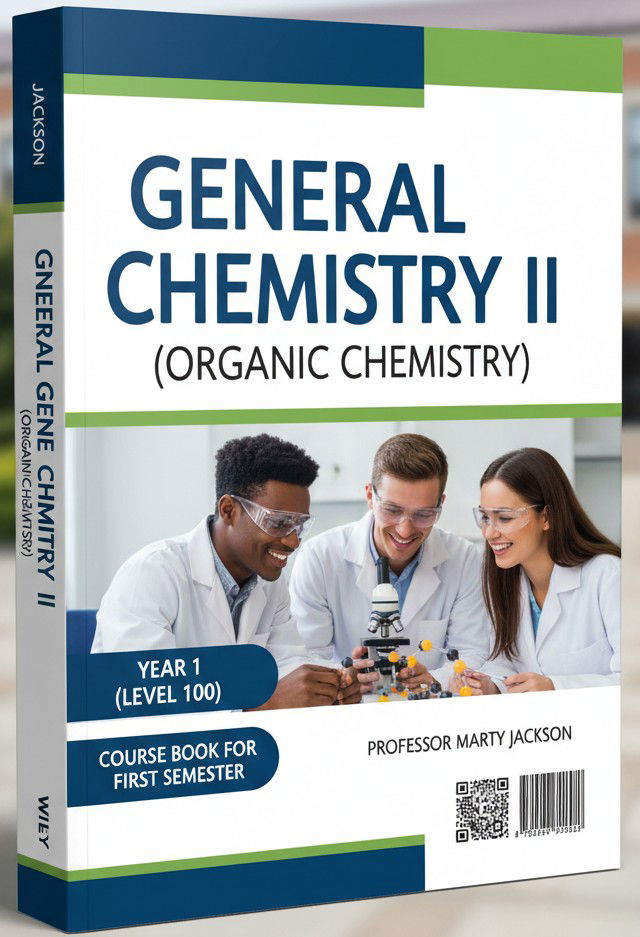
COURSE TITLE:
General Chemistry II introduces students to the foundational principles of Organic Chemistry, focusing on the structure, properties, reactions, and mechanisms of carbon-containing compounds. The course explores hydrocarbons, functional groups, stereochemistry, reaction pathways, and basic spectroscopy. It is designed to build analytical and problem-solving skills essential for advanced chemistry, biochemistry, medicine, pharmacy, and related fields.
This course emphasizes practical understanding, real-life applications, and the relevance of organic molecules in biological systems, industrial processes, and modern technology.
By the end of this course, students should be able to:
Organic chemistry is one of the most important branches of chemistry, centered on the study of carbon-containing compounds and the reactions, structures, and properties that define them. Although carbon is only the 15th most abundant element in the earth’s crust, it forms the basis of more than 90% of all known chemical compounds. This remarkable ability of carbon to form diverse compounds—ranging from simple molecules like methane to complex biological macromolecules like DNA and proteins—makes organic chemistry not just a scientific field, but a foundational language for understanding life, medicine, agriculture, material science, biotechnology, and countless industrial processes.
In General Chemistry II (Organic Chemistry), students move beyond the introductory atomic and molecular concepts learned in General Chemistry I and begin exploring how atoms, particularly carbon, bond to form millions of diverse structures. Organic chemistry is often viewed as challenging, not because it is inherently difficult, but because it requires students to think about molecules in three dimensions, understand mechanisms involving electron movements, recognize patterns of reactivity, and see connections between molecular structure and chemical behavior. This chapter provides a deep and detailed introduction to the subject, setting the foundation for the more advanced topics in subsequent chapters.
Organic chemistry is the branch of chemistry that studies the structure, properties, composition, reactions, and preparation of compounds containing carbon. Traditionally, organic chemistry focused only on compounds derived from living organisms; however, the modern definition includes all carbon compounds except for a few simple inorganics such as carbonates, carbides, carbon monoxide, and carbon dioxide.
The origin of organic chemistry can be traced back to ancient times when early humans used natural products such as plant extracts, oils, dyes, and alcohol fermented from grains. However, systematic scientific study began in the 18th and 19th centuries.
A major turning point came in 1828 when Friedrich Wöhler synthesized urea, an organic compound, from ammonium cyanate, an inorganic mineral. This historic experiment disproved the long-held “vital force theory,” which claimed that organic compounds could only be made by living organisms. Wöhler’s work marked the birth of modern organic chemistry and opened the door for the artificial synthesis of organic molecules in laboratories.
Organic chemistry is vast, covering many sub-disciplines, including:
The broad relevance of organic chemistry explains why it is a core requirement for students in medicine, pharmacy, biochemistry, agriculture, chemical engineering, and related fields.
Carbon is the backbone of organic chemistry because of its unique chemical characteristics. Several fundamental properties allow carbon to form a vast array of stable, complex compounds.
Carbon has an atomic number of 6 and an electronic configuration of 1s² 2s² 2p². The four valence electrons allow carbon to form four covalent bonds with other atoms. This tetravalency enables carbon to:
This property creates countless structural possibilities.
Catenation is the ability of carbon atoms to link together to form long chains, branched structures, and ring structures.
Carbon exhibits catenation more effectively than any other element due to:
Catenation leads to simple molecules like ethane as well as complex structures like DNA with millions of linked carbon atoms.
Carbon can form different types of covalent bonds:
Organic molecules often contain:
The presence of π bonds makes molecules more reactive and influences their geometry and physical properties.
Hybridization is the mixing of atomic orbitals to form new hybrid orbitals suitable for bonding.
Carbon undergoes three types of hybridization:
Hybridization helps explain molecular shape, bond angles, and reactivity patterns.
Organic compounds are classified based on molecular structure, functional groups, and carbon arrangement. The main categories are:
These compounds contain open chains of carbon atoms. They may be:
Aliphatic compounds form the basic backbone of organic chemistry.
These compounds have carbon atoms arranged in ring structures.
Non-aromatic rings such as:
Contain delocalized π electrons and follow Hückel’s rule. Examples:
Aromatic compounds have unique stability known as aromaticity.
Rings that contain one or more atoms other than carbon, such as:
Examples:
Heterocycles are important in pharmaceuticals like antibiotics, vitamins, and nucleic acids (DNA/RNA).
A functional group is an atom or group of atoms responsible for the chemical behavior of an organic molecule.
Common examples:
Organic reactions largely depend on the functional groups present.
Understanding molecular structure is crucial to predicting physical and chemical behaviors.
Lewis structures represent valence electrons and how atoms bond. They illustrate:
Lewis structures lay the foundation for understanding resonance and electronic effects.
Several types of structural formulas are used in organic chemistry:
Skeletal formulas are standard in advanced organic chemistry.
Organic molecules have bonding and antibonding orbitals. Molecular orbital theory explains:
This theory is essential for understanding resonance and stability patterns.
Different bonds have different properties:
These factors influence molecular shape and reactivity.
Isomers are compounds with the same molecular formula but different structures or arrangements. Isomerism highlights why organic chemistry has so many compounds despite limited elements.
There are two main classes:
These differ in how atoms are connected.
Types:
Example:
C₄H₁₀O can be butanol or diethyl ether.
Here atoms are connected in the same order but arranged differently in space.
Types:
Stereochemistry is crucial in drug design because two enantiomers can have drastically different effects in the body.
Organic chemistry touches every part of modern life. Some major areas include:
Most drugs are organic compounds. Examples:
Understanding organic functional groups and mechanisms is essential for designing effective medicines.
Organic chemistry contributes to:
Agricultural biotechnology relies heavily on organic and biochemical principles.
Hydrocarbons form the basis of:
Refineries use complex organic reactions like cracking, reforming, and polymerization.
Organic chemistry leads to modern materials such as:
Polymer chemistry revolutionized modern manufacturing.
Organic compounds provide:
These rely on functional groups such as esters, alcohols, and aldehydes.
Organic chemistry helps monitor and manage:
Organic chemistry is essential for sustainable development.
Before studying specific reactions, students must understand key principles:
Electronegativity differences cause:
These concepts are the driving force of organic reaction mechanisms.
The inductive effect refers to electron withdrawal or donation through sigma bonds.
Resonance stabilizes molecules with delocalized electrons, such as:
Resonance explains reactivity, stability, and physical properties.
Aromatic compounds are cyclic, planar, conjugated, and follow Hückel’s rule (4n+2 π electrons). Aromaticity gives unusual stability.
Examples:
Aromaticity influences reaction pathways significantly.
Organic reaction mechanisms use curved arrows to show electron movement. Understanding mechanisms is essential for:
Intermediates include:
Organic chemistry lab work involves volatile and sometimes hazardous chemicals. Safety protocols include:
Many solvents are flammable, toxic, or carcinogenic. Proper ventilation is crucial.
Different types of waste must be separated:
Because many organic solvents are flammable, fire extinguishers and fume hoods are essential.
Hydrocarbons are the simplest and most fundamental organic compounds because they are composed exclusively of carbon and hydrogen atoms. They serve as the backbone for all other organic compounds. By understanding hydrocarbons, one gains the essential foundation required for understanding the behavior, structure, reactions, and synthesis of more complex organic molecules.
Hydrocarbons are classified into aliphatic (alkanes, alkenes, alkynes) and aromatic types, each with distinct properties. Their structures influence their physical behavior, their chemical reactivity, and the types of reactions they undergo. Hydrocarbons dominate natural sources such as crude oil, natural gas, and coal, and they constitute the basis of fuels, plastics, pharmaceutical precursors, solvents, and industrial feedstocks.
This chapter provides a deep exploration of the four major classes of hydrocarbons with attention to:
Understanding hydrocarbons is indispensable for advanced organic chemistry, biochemistry, polymer science, medicinal chemistry, and industrial chemistry.
Alkanes are the simplest class of hydrocarbons. They are saturated, meaning all carbon–carbon bonds are single (σ) bonds, and carbon exhibits sp³ hybridization.
The general formula for alkanes is:
C_nH_{2n+2}These compounds form the structural basis of many fuels and lubricants.
Each carbon atom forms four sigma bonds arranged at an angle of 109.5°, yielding a tetrahedral geometry. This arrangement minimizes electron pair repulsion and ensures molecular stability.
The lack of π bonds explains why alkanes are relatively unreactive compared to unsaturated hydrocarbons and aromatic compounds.
Naming alkanes follows IUPAC rules:
This is the parent name: methane, ethane, propane, butane… up to decane and beyond.
Start numbering from the end nearest to the first substituent.
Common substituents include:
Example:
Alkanes show chain isomerism:
Example: C₄H₁₀
As carbon count increases, the number of isomers rises dramatically. C₁₀H₂₂ has 75 isomers, illustrating the diversity of alkane structures.
Because C–C single bonds rotate freely, alkanes exist in different conformations.
These show the spatial arrangement of substituents around C–C bonds.
Cycloalkanes exhibit angle strain and torsional strain:
The chair conformation is the most stable due to minimized torsional strain.
Alkanes are generally unreactive, but they undergo:
Complete combustion:
C_nH_{2n+2} + O_2 \rightarrow CO_2 + H_2OInadequate oxygen leads to incomplete combustion, producing CO or soot.
Occurs via chain reaction mechanism:
Step 1: Initiation
Cl_2 \rightarrow 2Cl^\bulletStep 2: Propagation
Cl^\bullet + CH_4 → HCl + CH_3^\bulletStep 3: Termination
Radicals combine to form stable products.
This reaction is central to industrial chlorination of methane and higher alkanes.
Alkenes are unsaturated hydrocarbons containing at least one carbon–carbon double bond (C=C). Their general formula:
C_nH_{2n}Alkenes are more reactive than alkanes due to the presence of a π bond, which is weaker and more reactive.
Each carbon in the C=C bond is sp² hybridized, giving a trigonal planar shape (bond angle ~120°).
A C=C bond consists of:
The π bond restricts rotation, leading to geometric isomerism.
Rules include:
Examples:
Occurs when each carbon of the double bond has two different groups.
Example:
Modern IUPAC uses the E/Z system:
Geometric isomers differ in boiling points, stability, and reactivity.
Alkenes undergo electrophilic addition reactions because the π bond is electron-rich.
Addition of hydrogen:
C=C + H_2 \rightarrow CH–CHUses metal catalysts: Pt, Pd, or Ni.
Addition of Cl₂ or Br₂ gives vicinal dihalides.
Color of bromine water disappears, used as a test for unsaturation.
Addition of HCl, HBr, or HI.
Markovnikov’s rule:
Hydrogen attaches to carbon with more hydrogens.
Addition of water in presence of acid to produce alcohols.
Alkenes form polymers such as:
Mechanisms include radical, cationic, or coordination polymerization.
Alkynes are hydrocarbons containing at least one carbon–carbon triple bond (C≡C).
General formula:
C_nH_{2n-2}They are more unsaturated than alkenes and undergo similar addition reactions.
Carbon is sp hybridized in alkynes.
Suffix = –yne
Examples:
Their acidity allows formation of acetylide ions, useful in synthesis.
Gives tetrahalides.
Follows Markovnikov’s rule.
Produces ketones (via enol intermediates).
Acetylene polymerizes to form polyacetylenes.
Aromatic hydrocarbons (arenes) include benzene and related compounds. They exhibit aromaticity, special stability due to electron delocalization.
Benzene (C₆H₆) is a planar ring with:
Kekulé proposed alternating double bonds, but modern theory shows all C–C bonds are equal.
A compound is aromatic if:
For benzene:
6 π electrons (n=1)
Other aromatic compounds include:
Aromaticity gives unusual stability.
Arenes resist addition but undergo substitution to preserve aromaticity.
Major reactions:
C_6H_6 + HNO_3 \rightarrow C_6H_5NO_2Requires a catalyst (FeBr₃, FeCl₃).
C_6H_6 + H_2SO_4 \rightarrow C_6H_5SO_3HUses AlCl₃.
Forms aromatic ketones.
Alkyl side chains undergo:
Example:
Toluene → benzoic acid (strong oxidants)
Hydrocarbons form the backbone of industrial civilization but pose environmental challenges.
Petroleum refining produces:
Processes such as cracking, reforming, and fractional distillation transform crude oil into useful products.
Hydrocarbons contribute to:
Incomplete combustion produces CO, a dangerous poison.
Aromatic hydrocarbons like benzene are carcinogenic.
Efforts to reduce hydrocarbon pollution include:
FUNCTIONAL GROUPS AND THEIR REACTIONS
Organic chemistry is vast, yet a deep understanding of its principles begins with one key concept: functional groups. A functional group is a specific group of atoms within a molecule that determines the characteristic chemical reactions of that molecule. The behavior, reactivity, and physical properties of organic compounds are dictated by these functional units, regardless of the rest of the carbon skeleton. For example, alcohols behave similarly because they all contain the –OH group, while carboxylic acids share acidic properties due to the –COOH functional group.
In this chapter, we explore the nature, structure, chemical properties, preparation, and reactions of the major functional groups in organic chemistry, including alcohols, phenols, aldehydes, ketones, carboxylic acids, acid derivatives, and amines. We also examine the electronic influences that govern the reactivity of these groups and learn how to predict their behavior using key principles like resonance, inductive effects, steric factors, and reaction mechanisms.
Functional groups not only dictate molecular behavior but also serve as the foundational language of organic chemistry. Mastery of them allows chemists to synthesize pharmaceuticals, design industrial chemicals, develop polymers, and understand biochemical pathways in living organisms. Thus, this chapter establishes a central pillar upon which advanced organic chemistry concepts rest.
Alcohols are organic compounds containing a hydroxyl group (–OH) bonded to a saturated carbon (sp³ hybridized). The general formula for alcohols is R–OH, where R is an alkyl group.
Alcohols are classified into three categories based on the carbon atom carrying the hydroxyl group:
Primary alcohols (1°):
–OH attached to a carbon bonded to one alkyl group.
Example: Ethanol (CH₃CH₂OH)
Secondary alcohols (2°):
–OH attached to a carbon bonded to two alkyl groups.
Example: Isopropanol (CH₃CHOHCH₃)
Tertiary alcohols (3°):
–OH attached to a carbon bonded to three alkyl groups.
Example: Tert‐butanol [(CH₃)₃COH]
This classification helps predict their reactivity, especially in oxidation and substitution reactions.
Alcohols have relatively high boiling points due to hydrogen bonding between molecules. As the carbon chain increases, boiling point increases because of stronger van der Waals forces.
Lower alcohols (methanol to butanol) dissolve in water due to formation of hydrogen bonds. Solubility decreases with increasing chain length as hydrophobic character increases.
Alcohols are weak acids with pKa values around 16–18. Their acidity depends on:
The oxygen atom can act as a Lewis base. Alcohols form hydrogen bonds and react with strong acids to produce oxonium ions (R–OH₂⁺).
Alkenes + water → alcohol
Using acid catalysts (H₂SO₄).
Follows Markovnikov’s rule.
Carbohydrates → ethanol + CO₂
Catalyzed by yeast enzymes.
RMgX + carbonyl compounds → alcohols after hydrolysis
Different carbonyls produce primary, secondary, or tertiary alcohols.
Oxidizing agents include:
Alcohols react with:
Alcohols + carboxylic acids → esters
Catalyzed by concentrated H₂SO₄.
Alcohols → alkenes + water
Carried out using H₂SO₄ or Al₂O₃ at 350°C.
Follows Zaitsev’s rule for major product.
Aldehydes and ketones are carbonyl compounds containing the carbonyl group (C=O), which is highly polar and reactive.
The carbonyl carbon is electrophilic, while oxygen is nucleophilic, making these compounds reactive toward nucleophiles.
Cleaves double bonds to form aldehydes or ketones.
Aromatic compounds + acyl chlorides → aromatic ketones.
This is the most important reaction type.
Examples:
Aldehydes and ketones can be reduced using:
Aldehydes are easily oxidized to carboxylic acids.
Ketones resist oxidation.
Common tests for aldehydes:
Ketones do not respond.
Alpha-halogenation occurs in acidic or basic conditions.
Aldehydes lacking α-hydrogens undergo disproportionation to form alcohols and carboxylic acids.
Carboxylic acids contain the carboxyl group (–COOH), a combination of carbonyl and hydroxyl groups.
Acid strength increases with electron-withdrawing groups (e.g., Cl, NO₂).
Using KMnO₄ or K₂Cr₂O₇.
Toluene → benzoic acid.
R–C≡N + H₂O → RCOOH.
RMgX + CO₂ → RCOOH.
Carboxylic acids react with:
Carboxylic acids → alcohols (LiAlH₄).
Loss of CO₂ when heated.
These include:
Their reactivity depends on the leaving group ability:Acid chlorides > anhydrides > esters > amides.
Carboxylic acids can be converted to:
This is the key reaction for acid derivatives.Nucleophiles attack the carbonyl carbon, displacing the leaving group.
Examples:
Amines are derivatives of ammonia (NH₃) in which hydrogen atoms are replaced by alkyl or aryl groups.
Classified as:
Amines + acids → ammonium salts.
Amines react with alkyl halides → produce secondary and tertiary amines.
Diazonium salts are used in dye formation.
Amines react with acid chlorides → amides (nucleophilic substitution).
Understanding electronic effects helps predict the reactivity of organic molecules.
Electron-withdrawing groups (–NO₂, –F, –Cl) stabilize negative charges but destabilize positive charges.
Electron-donating groups (alkyl groups) push electron density.
Aromatic ring substituents influence reactivity through resonance.
Occurs in alkyl groups attached to carbocations, stabilizing them.
Bulky groups hinder reaction progress, important in nucleophilic reactions.
Reactivity:
Acid chlorides > anhydrides > esters > amides.
Reactivity depends strongly on electron density at nitrogen.
Functional groups form the foundation of:
In analytical chemistry, functional groups are important in:
This chapter explored the major functional groups in organic chemistry and their characteristic reactions. We examined how alcohols, aldehydes, ketones, carboxylic acids, acid derivatives, and amines behave under different chemical conditions. We also studied the influence of electronic effects—such as inductive, resonance, and steric factors—on reactivity and stability. A strong comprehension of functional groups equips students with the tools needed to predict reaction pathways, understand molecular properties, and engage more deeply in advanced topics such as synthesis, medicinal chemistry, polymer chemistry, and biochemical reactions.
ORGANIC REACTION MECHANISMS AND SPECTROSCOPY
Organic chemistry is fundamentally the study of how and why organic molecules react. Every organic reaction—from the simplest substitution to complex biochemical transformations—is governed by a series of logical, stepwise events known as mechanisms. A mechanism describes the flow of electrons, the breaking and forming of bonds, the formation of intermediates, and the transition states that lead to new products. Understanding mechanisms does more than teach you how a reaction works; it helps you predict the outcomes of reactions you have never seen before.
Similarly, the second major pillar of this chapter is spectroscopy—the set of techniques used to determine the structure of organic molecules. While reaction mechanisms explain how molecules change, spectroscopy tells us what molecules look like. Techniques such as Infrared (IR) spectroscopy, Nuclear Magnetic Resonance (NMR) spectroscopy, and Mass Spectrometry (MS) are essential tools that allow chemists to identify molecules with remarkable precision.
Together, mechanisms + spectroscopy form the backbone of modern organic chemistry. Without them, synthesis, pharmaceutical chemistry, environmental chemistry, and materials science would not exist as we know them. This chapter brings both concepts together to form a complete understanding of how organic molecules behave, react, and can be identified.
A reaction mechanism is a detailed step-by-step description of how a chemical reaction occurs at the molecular level. It explains:
Organic chemists use curved arrows (→) to show electron flow from electron-rich sites (nucleophiles) to electron-poor sites (electrophiles). This arrow-pushing technique is essential for interpreting mechanisms.
They donate an electron pair.
Examples: ⁻OH, H₂O, ROH, NH₃, Cl⁻, Br⁻, CN⁻, R–O⁻, enolates.
Characteristics:
They accept an electron pair.
Examples: Carbocations (R³C⁺), carbonyl carbon, alkyl halides, proton sources (H⁺).
Characteristics:
Neutral species with unpaired electrons.
Generated during homolytic cleavage.
Reaction intermediates are unstable species that appear during the reaction but are not part of the final products.
Electron-deficient, planar sp² carbon.
Stability order:
Tertiary > Secondary > Primary > Methyl
Stabilized by:
Electron-rich, sp³ carbon.
Stability order:
Methyl > Primary > Secondary > Tertiary
Destabilized by alkyl groups due to electron repulsion.
Stability order similar to carbocations.
Highly reactive; important in cyclopropanation reactions.
Organic reactions fall into a few major categories:
Understanding these classes helps predict mechanisms.
Substitution reactions occur when one group replaces another. These reactions are most common in compounds containing leaving groups, such as alkyl halides.
The two key mechanisms are SN1 and SN2.
This reaction occurs in a single step:
Nucleophile + Substrate → Transition State → Product
Bulky substituents block backside attack, making SN2 impossible for tertiary carbon.
Occurs in two steps:
SN1 reactions may involve:
To form more stable carbocations.
| Feature | SN1 | SN2 |
|---|---|---|
| Steps | Two | One |
| Intermediate | Carbocation | None |
| Stereochemistry | Racemization | Inversion |
| Substrate | 3° > 2° | 1° > 2° |
| Nucleophile | Weak | Strong |
| Solvent | Protic | Aprotic |
Elimination reactions form alkenes from alkyl halides or alcohols.
The most substituted alkene is usually the major product, unless a bulky base is used.
Reaction pathway depends on:
Understanding this allows prediction of major reaction outcomes.
Addition reactions occur mainly in alkenes, alkynes, and carbonyl compounds.
This is the most common reaction of alkenes.
The proton adds to the carbon with more hydrogens; the nucleophile adds to the more substituted carbon.
Examples:
Occurs in the presence of peroxides (ROOR).
Example:HBr + peroxide → radical addition → product forms opposite of Markovnikov rule.
H₂ + catalyst (Pd, Pt, Ni) → reduces alkenes to alkanes.
Reactions include:
Mechanism involves formation of arenium ion.
Oxidation increases C–O bonds; reduction increases C–H bonds.
Examples:
Rearrangement reactions involve the migration of groups within a molecule.
These reactions often accompany carbocation formation.
Spectroscopy is used to determine molecular structure. The major techniques include:
Each gives different structural information.
IR measures molecular vibrations. Functional groups absorb at characteristic frequencies.
IR is especially useful for identifying functional groups.
NMR provides information about hydrogen and carbon environments.
Tells us:
A hydrogen with n neighbors splits into n + 1 peaks.
Carbonyl carbons appear downfield (160–220 ppm).
Alkyl carbons appear upfield (0–50 ppm).
MS determines molecular mass and fragments.
MS is essential for molecular weight determination.
To fully determine a molecule’s structure:
Together, these methods allow complete identification even of unknown compounds.
These concepts are essential in:
Chemists rely on mechanisms to design reactions and spectroscopy to verify products.
This chapter explored the detailed logic of how organic reactions occur and how molecules can be identified using spectroscopy. We examined substitution, elimination, addition, oxidation-reduction, and rearrangement reactions, along with the roles of nucleophiles, electrophiles, and intermediates. We also covered spectroscopy techniques such as IR, NMR, and MS, which together allow chemists to determine molecular structures with high accuracy.
Understanding reaction mechanisms allows prediction of product formation, while spectroscopy confirms the identity of those products. Together, they form the theoretical and practical foundation of all modern organic chemistry.